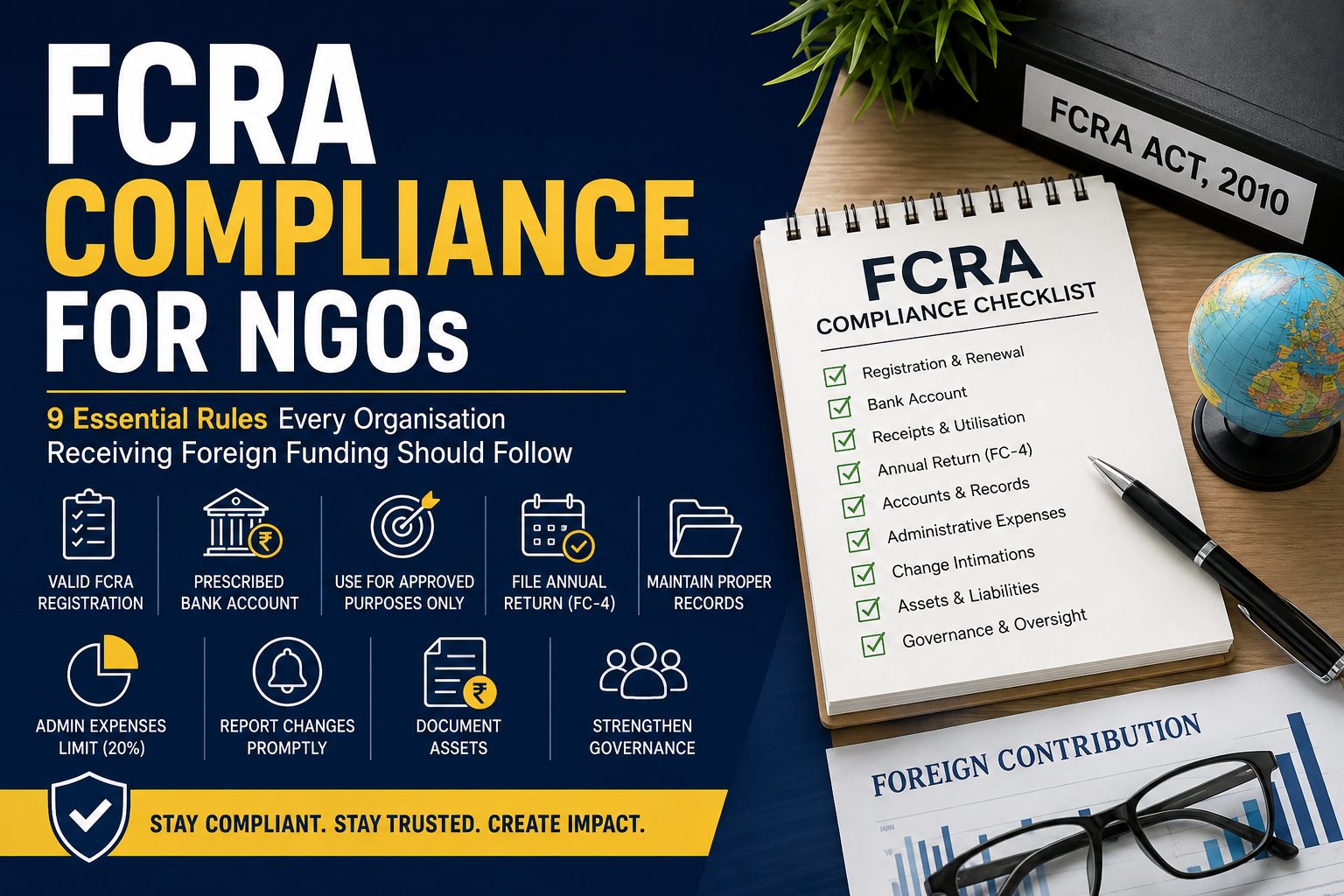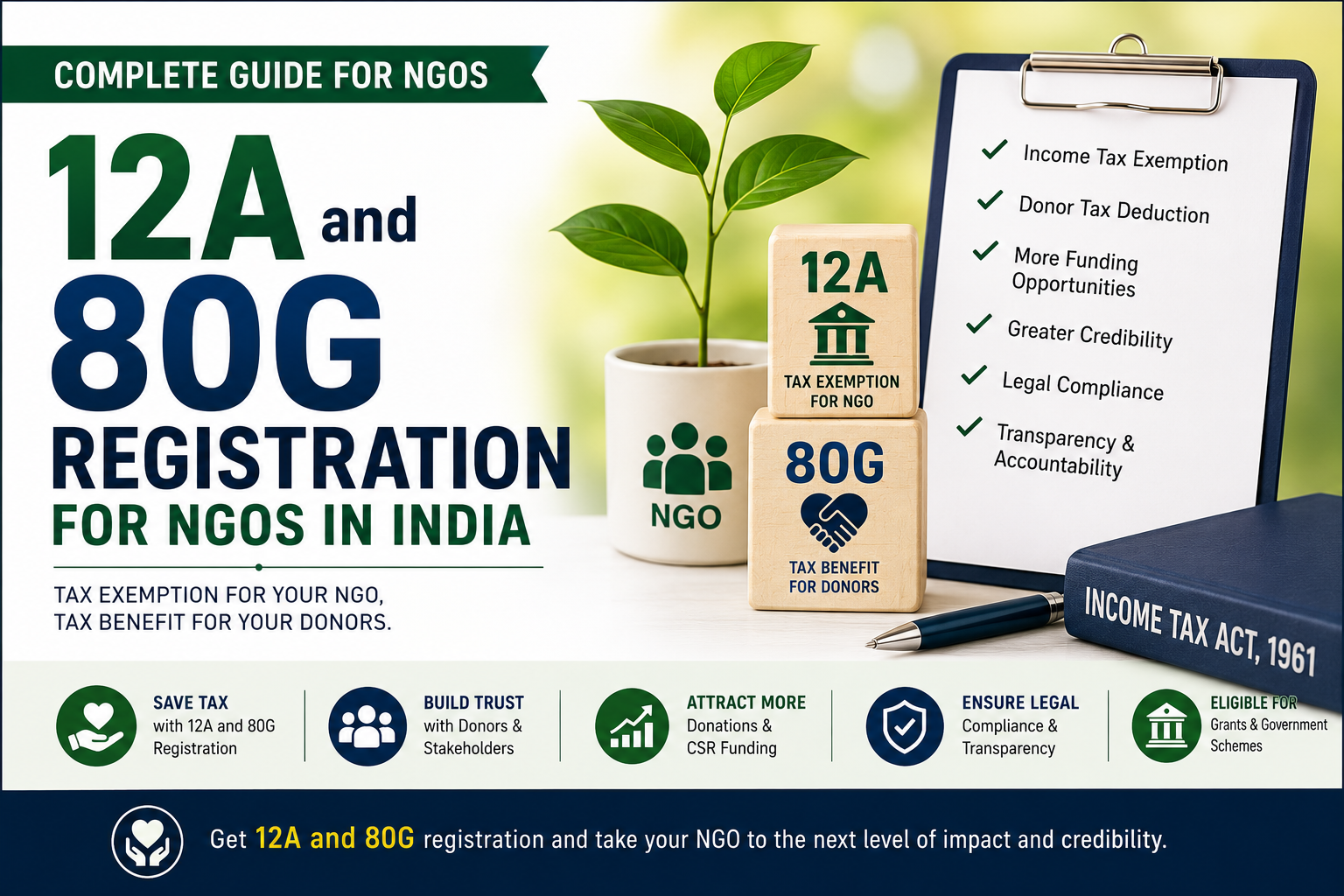
The FCRA Bill 2026 marks an important development in India’s regulatory framework for organisations receiving foreign contributions. Introduced in the Lok Sabha on 25 March 2026, the Foreign Contribution (Regulation) Amendment Bill, 2026 proposes changes to the Foreign Contribution (Regulation) Act, 2010, particularly around the treatment of foreign-funded assets, cessation of FCRA registration, investigations, penalties and organisational accountability.
However, there is an important distinction that NGOs should understand.
The FCRA Bill 2026 is not yet law. As of 28 August 2026, it is under consideration by Parliament and was referred to a Joint Parliamentary Committee (JPC) on 12 August 2026. Therefore, the proposals discussed in this article should not be treated as current legal requirements until Parliament completes the legislative process and the provisions come into force.
At the same time, another major development has already taken effect: the Foreign Contribution (Regulation) Amendment Rules, 2026 were notified on 22 June 2026 and are currently in force. These Rules introduce more specific requirements concerning the purposes and geographical areas of operation, utilisation of foreign contribution, renewal and annual reporting.
For NGOs, therefore, 2026 is not simply about one new Bill. It is about understanding two connected developments:
- FCRA Amendment Rules, 2026 — already in force
- FCRA Amendment Bill, 2026 — proposed and under parliamentary consideration
This distinction is critical for organisations that depend on foreign grants, international donors, humanitarian funding or overseas institutional partnerships.
What Is FCRA?
Before understanding the FCRA Bill 2026, it is important to understand what FCRA means.
FCRA stands for the Foreign Contribution (Regulation) Act.
The FCRA regulates the acceptance and utilisation of foreign contributions and foreign hospitality in India. Organisations receiving foreign contributions for their activities generally need an FCRA registration certificate or, where applicable, prior permission from the Central Government.
The framework is intended to regulate foreign funding while preventing its misuse in ways that could adversely affect national interest, public order or national security.
The 2010 Act replaced the earlier 1976 framework and introduced a five-year renewable FCRA registration along with a prior-permission route for organisations receiving foreign contribution for a specific purpose and source.
For development-sector organisations, FCRA compliance therefore affects much more than accounting. It can influence:
- International grants
- Foreign institutional donors
- Overseas philanthropic funding
- Humanitarian programmes
- Research funding
- International partnerships
- Foreign-funded infrastructure
- NGO governance
FCRA Bill 2026: What Is the Current Status?
The FCRA Amendment Bill 2026 was introduced in the Lok Sabha on 25 March 2026.
It was subsequently referred to a Joint Parliamentary Committee on 12 August 2026. As of the date of this article, it remains under consideration and has not become an enacted amendment law.
This means NGOs should be careful when reading headlines such as “FCRA Bill Passed”.
The Bill has been introduced and referred to a parliamentary committee, but that is different from being passed by Parliament and receiving all necessary approvals for commencement.
What is already applicable?
The FCRA Amendment Rules 2026, notified on 22 June 2026, are already in force.
What remains proposed?
Changes contained specifically in the FCRA Bill 2026, including the proposed Designated Authority and permanent vesting framework, remain subject to the parliamentary process.
For NGOs, the practical approach is simple:
Comply with the Rules that are already in force, while preparing for the possible impact of the proposed Bill.
7 Important Changes Under the FCRA Bill 2026
1. New Framework for Foreign-Funded Assets
The most significant feature of the FCRA Bill 2026 concerns what happens to foreign contributions and assets created from those contributions when an organisation loses its FCRA registration.
Under the existing FCRA framework, Section 15 already provides for foreign contribution and assets created from it to vest in a prescribed authority when registration is cancelled or surrendered. However, the government says that the existing framework does not provide sufficient detail on how those assets should be taken into custody, managed or ultimately disposed of.
The proposed Bill seeks to establish a much more detailed statutory framework.
This would cover situations where an organisation’s FCRA registration:
- Is cancelled
- Is surrendered
- Is not renewed
- Has renewal refused
- Otherwise ceases
The proposed framework would apply not simply to unused foreign funds but also to assets created wholly or partly from foreign contribution.
Why does this matter?
Imagine an NGO has used foreign funding over several years to establish:
- A school building
- A healthcare centre
- A community training facility
- Equipment
- Vehicles
- Other programme infrastructure
If its FCRA registration subsequently ceases, the treatment of those assets becomes extremely important.
The proposed Bill attempts to establish a formal process rather than leaving such assets in an uncertain administrative position.
2. Creation of a Designated Authority
The FCRA Bill 2026 proposes the creation of a Designated Authority responsible for the vesting, supervision, management and disposal of foreign contributions and assets covered by the proposed framework.
This is one of the biggest structural changes proposed by the Bill.
Under the proposed system, when an organisation’s FCRA registration ends, assets would initially vest provisionally with the Designated Authority.
The organisation could potentially have those assets returned if its registration is renewed, restored or fresh registration is granted within the prescribed period.
The proposed Designated Authority would also have responsibilities relating to:
- Maintaining records
- Maintaining inventories
- Maintaining accounts
- Reporting violations
- Managing vested assets
- Following directions of the Central Government
The Bill would also give the authority powers concerning inspection and access to books, records, premises and property in situations covered by the proposed framework.
3. Provisional vs Permanent Vesting of Assets
This is perhaps the most important concept for NGOs to understand.
The Bill proposes a two-stage approach.
Stage 1: Provisional Vesting
When the FCRA registration ceases, the relevant foreign contribution and assets would provisionally vest in the Designated Authority.
This does not necessarily mean immediate permanent loss.
If the organisation successfully obtains renewal, restoration or fresh registration within the prescribed period, the Bill provides for the return of the relevant unutilised foreign contribution and assets, subject to the proposed framework.
Stage 2: Permanent Vesting
If the organisation does not obtain restoration, renewal or fresh registration within the prescribed period, the proposed framework provides for permanent vesting.
The Designated Authority could then use the assets for public purposes, including transferring them to government departments or other public authorities.
Alternatively, assets may be disposed of, with the proceeds and unutilised foreign contribution credited to the Consolidated Fund of India, subject to the Bill’s provisions.
Example
Suppose an NGO receives foreign funding and uses it to establish a community health centre.
Later, its FCRA registration expires and is not renewed.
Under the proposed framework:
Registration ends → assets provisionally vest → NGO gets an opportunity within the prescribed framework to restore/renew → if restored, assets can be returned → if not restored, permanent vesting may occur.
This is why FCRA renewal becomes more than a routine administrative deadline.
4. Special Protection for Places of Worship
The Bill specifically addresses assets that are wholly or partly used as places of worship.
If such an asset permanently vests under the proposed framework, the Designated Authority would be required to ensure that its religious character is maintained.
The government has also clarified that the proposed framework does not mean that all assets of an NGO would automatically be taken over.
The proposed provisions relate to assets covered by the FCRA framework, particularly assets created from foreign contributions, and would operate when the organisation’s FCRA registration has lawfully ceased.
This distinction is particularly important for faith-based organisations receiving foreign contributions.
5. New Responsibilities for Key Functionaries
The FCRA Bill 2026 also proposes clearer statutory recognition of key functionaries within organisations.
The proposed definition includes people such as:
- Directors of companies
- Partners in firms
- Trustees
- Karta of a Hindu Undivided Family
- Office bearers
- Governing body members
- Managing committee members
- Other persons responsible for management
The Bill proposes that key functionaries could be held responsible for organisational offences unless they establish that the offence occurred without their knowledge or that they exercised due diligence.
What does this mean for NGOs?
FCRA compliance should not be treated as the responsibility of only the finance department.
Boards, trustees, directors and senior management should understand:
- Where foreign funds come from
- How funds are utilised
- What projects they support
- Whether reporting is accurate
- Whether FCRA conditions are being followed
- When registration needs renewal
This makes governance increasingly important for NGOs receiving foreign funding.
6. Changes to Investigations and Penalties
Another important proposal concerns enforcement.
The Bill proposes reducing the maximum imprisonment for contraventions of the FCRA from five years to one year, while retaining the possibility of a fine or both.
At the same time, the Bill proposes a more coordinated approach to investigations.
It provides for prior Central Government approval before initiation of an investigation for an offence under the Act.
The government’s stated rationale is that FCRA is a central law dealing with areas including foreign relations and national security, and therefore investigation should operate through a coordinated framework.
For NGOs, this does not mean that compliance becomes less important.
The proposed reduction in the maximum imprisonment term should not be interpreted as a relaxation of the FCRA framework overall. The Bill simultaneously proposes stronger administrative mechanisms around assets, investigations and organisational responsibility.
7. Time Limits for Prior Permission and Registration Cessation
The FCRA Bill 2026 also proposes changes relating to organisations that receive foreign contribution through prior permission.
Under the existing framework, prior permission is granted for a specific purpose and source. The Bill proposes that such foreign contribution must be received and utilised within a prescribed time period.
The Bill also proposes a new provision dealing with cessation of an FCRA certificate.
A registration could cease where:
- It is not renewed before expiry
- No renewal application is made
- Renewal is refused
The proposal is intended to provide greater clarity around the legal status of organisations after the registration period ends.
FCRA Amendment Rules 2026: Changes Already in Force
The Bill gets most of the attention, but NGOs should not overlook the FCRA Amendment Rules 2026.
These Rules were notified on 22 June 2026 and are already in force.
Some of the important changes include the following.
Purpose-Specific Registration
FCRA registration now requires greater specificity regarding the purpose or purposes for which foreign contribution will be used.
The certificate is linked to specified purposes and the States or Union Territories in which the organisation operates, selected from a prescribed Schedule.
Existing associations have been given a period to intimate the purposes and States/UTs they wish to retain.
Why is this important?
An NGO should no longer think of its FCRA registration simply as a broad permission to receive foreign money.
It needs to maintain alignment between:
Registered purpose → approved geography → project activity → utilisation → reporting
This creates a more traceable compliance chain.
Minimum Utilisation Requirement for Renewal
One of the most significant changes under the 2026 Rules is the utilisation requirement for organisations seeking renewal.
NGOs renewing FCRA registration must demonstrate utilisation of at least ₹10 lakh in foreign contribution during the preceding two years, subject to the applicable framework.
This is important for smaller organisations that maintain an FCRA registration but receive or utilise very little foreign contribution.
Example
Imagine NGO A has an FCRA registration but has utilised only ₹3 lakh in foreign contribution during the relevant two-year period.
Under the new Rules, the organisation needs to carefully assess whether it meets the applicable renewal requirement and maintain documentary evidence of its utilisation.
This makes active and proper utilisation of foreign contribution increasingly important.
Enhanced Annual Reporting
The 2026 Rules also increase the level of information expected in annual reporting.
The government says annual returns will include greater project-wise and activity-wise utilisation information, along with disclosure relating to the organisation’s website, social media and ultimate foreign donor, including where funds move through intermediary channels.
This means NGOs should strengthen their internal information systems.
A finance team should be able to connect:
Donor → Foreign contribution received → Project → Activity → Expenditure → Beneficiary/Outcome → Report
The ability to produce this information accurately can become increasingly important during compliance reviews and donor due diligence.
What the FCRA Bill 2026 Means for NGOs
The proposed Bill and the Rules already in force together point toward a broader shift in FCRA compliance.
The direction is increasingly focused on:
1. Greater traceability
Authorities want to understand where foreign contribution comes from and how it is ultimately used.
2. Stronger organisational accountability
Trustees, directors and other key functionaries may need to take a more active role in compliance.
3. More precise activity reporting
Broad descriptions of activities may no longer be sufficient for organisations operating under increasingly specific registration requirements.
4. Greater importance of renewal
FCRA renewal should be treated as a strategic governance deadline rather than routine paperwork.
5. Stronger asset-level accountability
Organisations using foreign funds to create assets should maintain clear records demonstrating the source and utilisation of funds.
Practical Example: How the Changes Could Affect an NGO
Consider a fictional organisation called Sahyog Foundation.
It receives foreign funding for healthcare and rural development programmes.
The NGO uses foreign contributions to:
- Operate mobile health clinics
- Train community health workers
- Purchase medical equipment
- Establish a small health centre
Under the 2026 compliance environment, Sahyog Foundation should maintain clear records showing:
Foreign donor → FCRA receipt → Approved purpose → State/UT → Project → Expenditure → Asset created
It should also monitor its FCRA renewal date and ensure that its utilisation and reporting records satisfy the applicable requirements.
If the proposed Bill becomes law, the consequences of allowing registration to cease could become even more significant because foreign-funded assets could enter the proposed vesting framework.
The lesson is straightforward:
FCRA compliance should be treated as an organisational governance function, not merely an accounting task.
What NGOs Should Do Now
Even though the FCRA Bill 2026 remains under parliamentary consideration, NGOs do not need to wait before improving their compliance systems.
Review Your FCRA Certificate
Check:
- Expiry date
- Registered purposes
- Approved States/UTs
- Organisation details
- Key functionaries
Review Foreign Contribution Utilisation
Maintain a clear record of:
- Amount received
- Donor
- Date received
- Project
- Activity
- Expenditure
- Balance
Review Foreign-Funded Assets
Create an internal asset register identifying assets purchased or created using foreign contribution.
This can become particularly important if the proposed asset-vesting provisions become law.
Strengthen Board Oversight
Trustees and directors should receive periodic FCRA compliance reports rather than leaving everything to the accounts team.
Review Annual Reporting
Ensure project-wise and activity-wise records are maintained so that information can be accurately reported.
Track Renewal Deadlines
Do not wait until the last moment to prepare an FCRA renewal application.
FCRA Bill 2026 vs FCRA Rules 2026
| Area | FCRA Bill 2026 | FCRA Rules 2026 |
|---|---|---|
| Status | Proposed; under parliamentary consideration | Notified and in force |
| Introduction/notification | Bill introduced 25 March 2026 | Rules notified 22 June 2026 |
| Asset management | Proposes detailed vesting framework | Existing compliance framework continues |
| Designated Authority | Proposed | Not applicable as a Bill provision |
| Registration purpose | Legislative changes proposed | More specific purpose and geography requirements |
| Renewal | Proposed cessation provisions | ₹10 lakh utilisation requirement for renewal |
| Reporting | Legislative changes proposed | Enhanced project/activity/donor disclosures |
| Penalties | Maximum imprisonment proposed to reduce to one year | Rules provide operational compliance requirements |
| Investigations | Central approval proposed | Existing framework applies unless changed by law |
The key takeaway is that the Bill and Rules should not be treated as the same legal development. The Rules are already operative; the Bill remains subject to Parliament’s consideration.
Conclusion
The FCRA Bill 2026 represents an important proposed shift in how India may regulate foreign-funded organisations, particularly when FCRA registration ends and foreign-funded assets remain with an organisation.
Its proposed Designated Authority, provisional and permanent asset-vesting framework, key-functionary provisions, investigation changes and rationalised penalties could have significant implications for NGOs receiving foreign contributions.
At the same time, NGOs should not overlook what has already changed.
The FCRA Amendment Rules 2026 are already in force, bringing greater specificity around approved purposes and geographical areas, introducing a minimum utilisation requirement for renewal, and strengthening annual reporting requirements.
For NGOs, the message is clear: FCRA compliance is becoming increasingly detailed, evidence-based and governance-oriented.
Organisations receiving foreign funding should therefore maintain accurate financial records, monitor renewal deadlines, document foreign-funded assets, strengthen board oversight and ensure that their actual activities remain aligned with their approved FCRA purposes.
Most importantly, NGOs should distinguish between what is already legally applicable under the 2026 Rules and what is still proposed under the FCRA Bill 2026.
As the parliamentary process continues, DevelopmentSector.com will continue to track significant changes affecting NGOs, foreign funding and India’s development sector.
Has the FCRA Bill 2026 been passed?
No. The Bill was introduced in the Lok Sabha on 25 March 2026 and referred to a Joint Parliamentary Committee on 12 August 2026. It remains under parliamentary consideration as of 28 August 2026.
What is the main purpose of the FCRA Bill 2026?
A major objective is to create a clearer statutory framework for the supervision, management and disposal of foreign contributions and assets when an organisation’s FCRA registration ends.
What happens to NGO assets under the proposed Bill?
Relevant foreign-funded assets would initially be subject to provisional vesting with the proposed Designated Authority. If registration is restored within the prescribed period, the framework provides for return of relevant assets and unused funds. Otherwise, permanent vesting could follow.
Does cancellation of FCRA registration mean all NGO assets are taken over?
No. The proposed framework concerns foreign contributions and assets covered by the FCRA provisions. It does not mean that every asset owned by an NGO is automatically taken over.
Are the FCRA Amendment Rules 2026 already effective?
Yes. The revised Rules were notified on 22 June 2026 and are in force.
What is the ₹10 lakh FCRA requirement?
Under the 2026 Rules, organisations seeking renewal must demonstrate utilisation of at least ₹10 lakh in foreign contribution over the preceding two years, subject to the applicable provisions.
Will the FCRA Bill 2026 definitely become law in its current form?
Not necessarily. Because the Bill is still under parliamentary consideration, its provisions may be examined, modified or otherwise changed during the legislative process.