The implementation of the National Education Policy (NEP) 2020 has introduced one of the most significant structural changes in Indian higher education in recent decades. Among its many reforms, the emergence of the four-year undergraduate degree and the possibility of a one-year master’s programme for eligible students have Confused between a 3-year vs 4-year bachelor’s degree and also sparked an important debate.
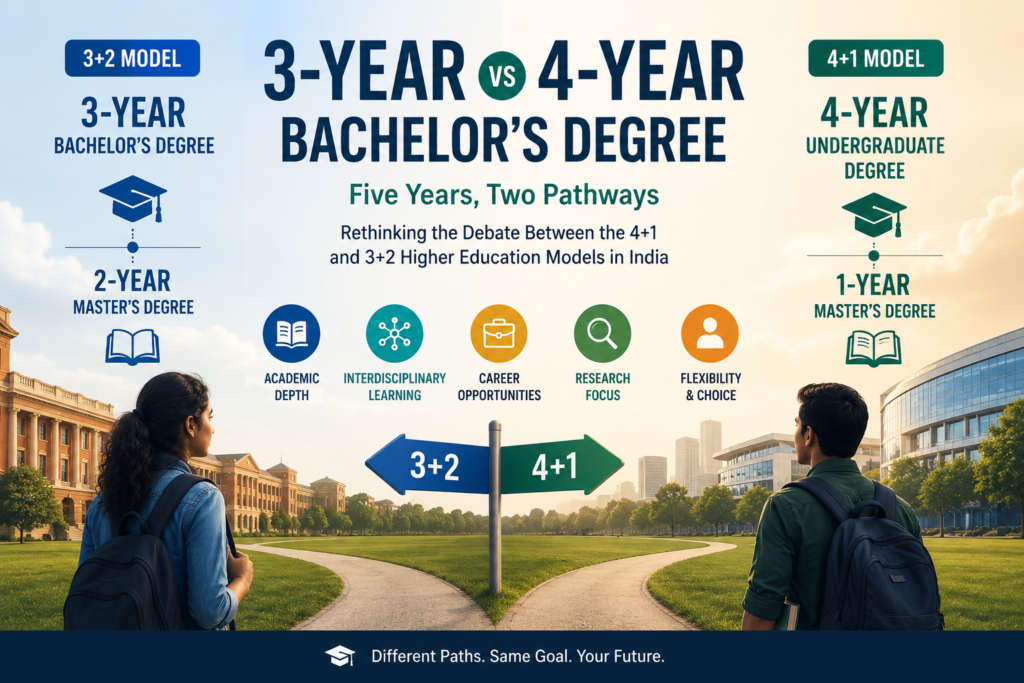
Traditionally, Indian students followed a three-year bachelor’s degree followed by a two-year master’s degree. Under the new framework, many students may complete a four-year undergraduate program and subsequently pursue a one-year master’s degree, resulting in the same total duration of five years.
At first glance, both pathways appear equivalent.
- Both require five years of study.
- Both culminate in a master’s qualification.
- Both are expected to prepare students for employment, research, and professional advancement.
Yet beneath this apparent similarity lies a more complex question:
Do these pathways produce the same kind of graduate?
The answer is not necessarily. When comparing a 3-Year vs 4-Year Bachelor’s Degree, the real distinction lies not in the number of years spent studying, but in the educational philosophy that shapes the learning experience.
How the Traditional 3+2 Model Works
For decades, the three-year bachelor’s followed by a two-year master’s structure has shaped higher education in India.
Its underlying logic is straightforward. When evaluating a 3-Year vs 4-Year Bachelor’s Degree, the traditional 3+2 model is often associated with greater postgraduate specialisation.
The undergraduate years provide foundational exposure to a discipline, while the postgraduate years are dedicated to advanced specialization. The master’s degree serves as a distinct academic phase where students engage with more complex theoretical frameworks, research methodologies, professional practice, and critical analysis.
In disciplines such as social work, psychology, sociology, economics, public policy, and education, the transition from undergraduate to postgraduate study often marks a significant intellectual shift.
Students are no longer merely learning about a subject. They are learning to think within the subject. The two-year master’s creates space for this transformation. It allows students to deepen their disciplinary identity, develop advanced analytical skills, and engage more meaningfully with research and practice.

How the New 4+1 Model Works
TThe discussion surrounding a 3-Year vs 4-Year Bachelor’s Degree frequently focuses on the flexibility offered by the new 4+1 structure.
The four-year undergraduate model is based on a different philosophy.
Rather than treating undergraduate and postgraduate education as clearly distinct stages, it seeks to strengthen the undergraduate experience itself.
The additional undergraduate year often incorporates:
– Research components
– Interdisciplinary learning
– Advanced coursework
– Skill development
– Field engagement
– Academic flexibility
As a result, students may enter a one-year master’s program with stronger academic preparation than previous undergraduate cohorts.
The one-year master’s is therefore designed not as a condensed version of a traditional postgraduate degree but as a continuation of an already advanced undergraduate experience.
In theory, this creates a more seamless educational trajectory.
Instead of spending two years acquiring postgraduate competencies, students begin developing them during the final stages of undergraduate study.
3-Year vs 4-Year Bachelor’s Degree: Which Offers Better Career Opportunities?

The debate between the two models ultimately reflects a broader tension within higher education.
Should universities prioritize breadth or depth?
The 4+1 model tends to encourage broader academic exposure.
Students often have greater opportunities to engage with multiple disciplines, explore electives, participate in research, and acquire diverse skill sets.
Employers evaluating graduates from a 3-Year vs 4-Year Bachelor’s Degree pathway are often more concerned with skills than duration.
The 3+2 model tends to prioritize disciplinary depth.
Students spend a longer period immersed in specialized postgraduate learning.
Neither approach is inherently superior.
However, they may serve different educational and professional objectives.
A student seeking interdisciplinary competence may benefit from the flexibility of the 4+1 structure.
A student seeking deep professional expertise may find the traditional 3+2 pathway more advantageous.
Research and Academic Outcomes in the 3+2 and 4+1 Models

One of the key considerations in the 3-Year vs 4-Year Bachelor’s Degree debate is the quality of research training.
Employers increasingly seek graduates who can adapt to changing environments, work across disciplines, and combine technical knowledge with practical skills.
The additional undergraduate year can provide opportunities for internships, research projects, and experiential learning that may improve workplace readiness.
However, employability is not determined solely by degree structure.
Employers continue to value practical experience, communication skills, critical thinking, and professional competence.
A poorly designed 4+1 program will not necessarily outperform a rigorous 3+2 pathway.
Similarly, a highly motivated student completing a traditional master’s degree may possess stronger expertise than a graduate emerging from an integrated model.
The quality of education remains more important than the architecture of education.
The Research Question
The 3-Year vs 4-Year Bachelor’s Degree discussion should not distract from the larger issue of educational quality.
The traditional two-year master’s degree offers a longer period for engaging with advanced methodologies, independent inquiry, and academic specialization. Students interested in doctoral studies often benefit from this extended period of intellectual development.
The 4+1 model attempts to compensate by introducing research components during undergraduate study. Whether this produces comparable outcomes remains an open question.
The answer will likely depend on how effectively institutions implement the new framework.
At present, many Indian universities are still navigating this transition.
Consequently, the success of the 4+1 model will depend less on policy design and more on institutional capacity.
What Does NEP 2020 Mean for Students?
Much of the public discussion surrounding higher education reform focuses on duration and degree structures. Yet this focus may be misplaced.
The central challenge facing Indian higher education has never been whether a program lasts three years, four years, or five years. The challenge has always been quality.
A four-year undergraduate degree cannot compensate for weak teaching, limited research opportunities, inadequate field exposure, or outdated curricula.
Similarly, a two-year master’s degree cannot guarantee expertise in the absence of rigorous academic engagement.
The risk in this debate is that students begin to view educational structures as substitutes for educational quality.
They are not.
A strong academic environment will produce competent graduates regardless of the pathway.
A weak academic environment will undermine both models equally.
3-Year vs 4-Year Bachelor’s Degree: Which Path Should You Choose?
Perhaps the most important question is not which pathway is better. Rather, it is what kind of graduate India seeks to produce.
The challenges confronting contemporary society such as climate change, technological disruption, inequality, public health crises, and social fragmentation require individuals capable of both specialized expertise and interdisciplinary thinking.
The future may therefore demand a synthesis of both models.
Students need depth, but they also need flexibility. They need professional competence, but they also need adaptability. They need specialization, but they also need the ability to engage with problems that transcend disciplinary boundaries.
The true success of higher education reform will not be determined by whether students complete a 4+1 or a 3+2 pathway.
It will be determined by whether universities can cultivate graduates who possess the intellectual capacity, professional competence, and social awareness necessary to navigate an increasingly complex world.
Interested in building a career in the social sector? Explore the latest development sector jobs, NGO careers, internships, fellowships, and CSR opportunities on DevelopmentSector.com and stay updated with insights shaping the future of social impact.
Conclusion
The debate between the 4+1 and 3+2 models should not be reduced to a question of which degree structure is superior.
Both pathways represent different approaches to achieving the same objective: preparing students for meaningful professional, academic, and social engagement.
The traditional 3+2 model offers greater opportunities for disciplinary depth and extended specialization. The emerging 4+1 model emphasizes integration, flexibility, and a stronger undergraduate foundation.
Ultimately, the value of either pathway depends not on the number of years spent in higher education but on the quality of learning that occurs during those years.
In the long run, employers, universities, and society are unlikely to reward students for choosing one structure over another. They will reward those who emerge with the ability to think critically, learn continuously, and apply knowledge effectively.
The future of higher education is therefore not a debate about years. It is a debate about what those years are used for.