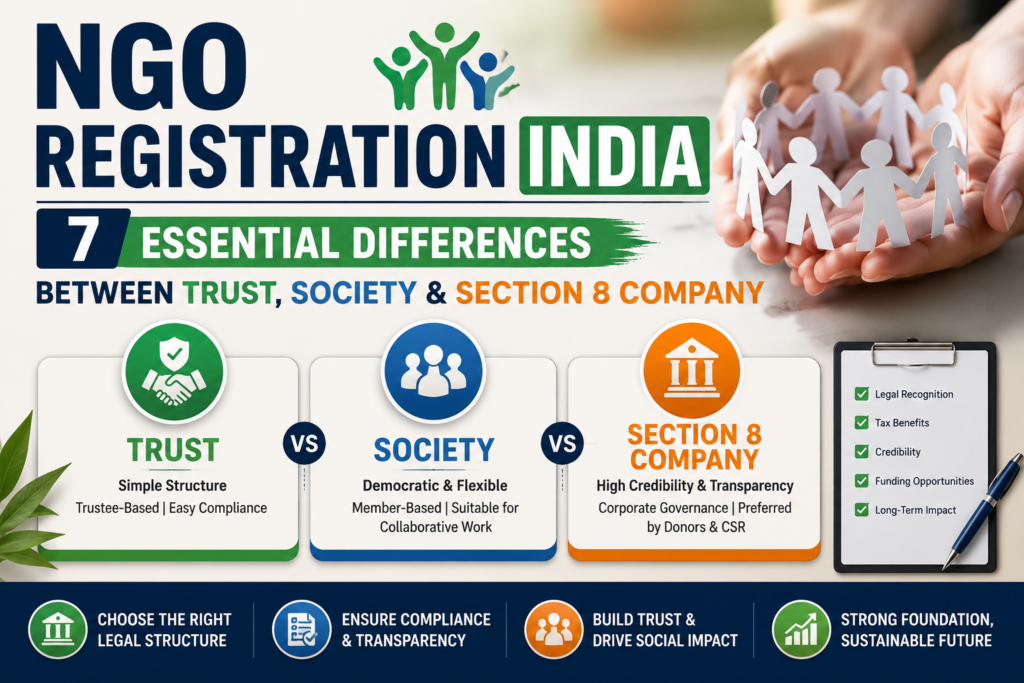
NGO registration India is the first and most important step in establishing a legally recognized non-profit organization. Whether you want to start a charitable trust, a society, or a Section 8 Company, choosing the right legal structure will influence your governance, funding opportunities, compliance requirements, and long-term impact.
The three most common legal structures for NGO registration in India are Trusts, Societies, and Section 8 Companies. While all three can operate as non-profit organizations, they differ in terms of registration process, legal framework, management, transparency, and regulatory obligations.
This guide explains the differences between each structure to help founders, social entrepreneurs, and development professionals make an informed decision.
NGO Registration India: What Is It?
NGO registration in India refers to the legal process of establishing a non-profit organization under the appropriate law. Registering an NGO provides legal recognition, enables organizations to open bank accounts, apply for grants, receive donations, and access tax exemptions and government schemes.
The three primary legal structures are:
- Public Charitable Trust
- Registered Society
- Section 8 Company
Each structure serves different organizational needs and objectives.
NGO Registration India: Types of Legal Structures
1. Trust Registration in India
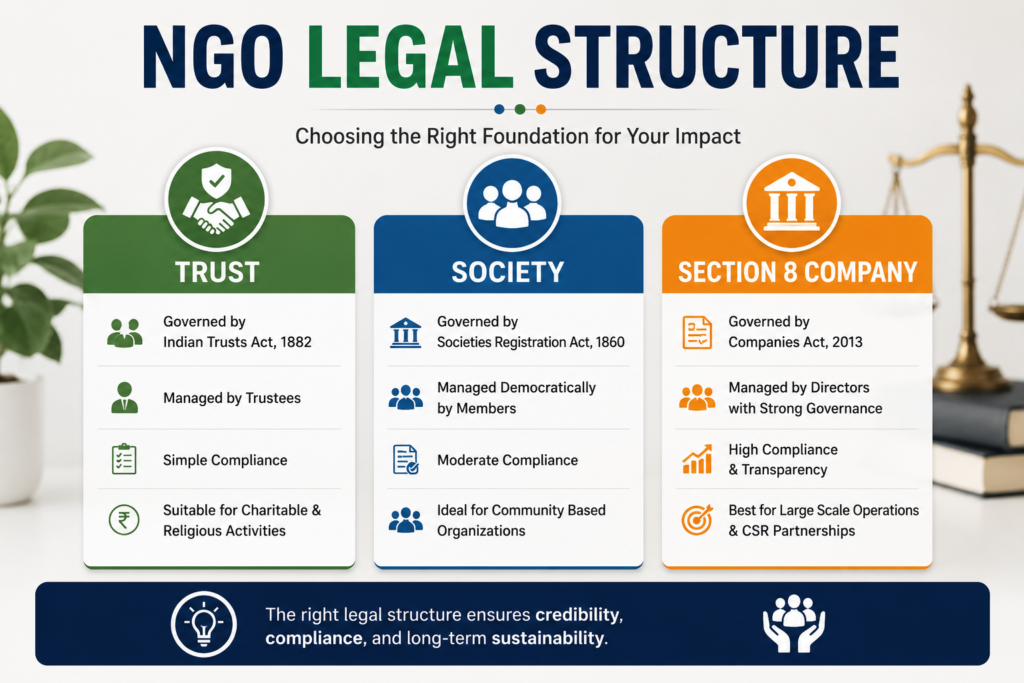
A Trust is one of the oldest and simplest forms of nonprofit organization in India. It is generally established for charitable, religious, educational, or social welfare purposes. Trusts are created when a settlor transfers property or assets to trustees, who manage them for the benefit of beneficiaries or the public at large. This structure is particularly suitable for organizations that aim to operate with a stable and long-term vision, especially where asset management is involved.
Governed by:
- Indian Trusts Act, 1882 (private trusts)
- State Public Trust Acts (where applicable)
Suitable for:
- Charitable institutions
- Educational organizations
- Healthcare initiatives
- Religious organizations
Advantages
- Simple registration process with minimal documentation
- Lower compliance burden compared to other NGO structures
- Strong asset protection and continuity
- Stable governance with fewer internal conflicts
Limitations
- Limited democratic participation among stakeholders
- Trustees hold significant decision-making authority
- Difficult to modify objectives once established
- Less transparency compared to corporate structures
Trusts are ideal for founders who prefer centralized control and minimal regulatory complexity. However, they may not be the best choice for organizations that require broad participation or frequent governance changes.
2. Society Registration in India
A Society is a membership-based organization formed by individuals who come together to promote charitable, literary, scientific, educational, or cultural objectives. It operates on democratic principles, where decisions are made collectively by members through a governing body or executive committee. Societies are particularly suitable for organizations that involve multiple stakeholders and require collaborative decision-making.
Governed by:
- Societies Registration Act, 1860
Suitable for:
- Community-based organizations
- Educational institutions
- Professional associations
- Cultural organizations
- NGOs with multiple stakeholders
Advantages
- Democratic management with elected governing bodies
- Flexible membership structure allowing expansion
- Encourages participation and accountability
- Suitable for collaborative and community-driven initiatives
Limitations
- Mandatory annual compliance and reporting requirements
- Internal elections can lead to conflicts or delays
- State-specific registration rules may vary
- Governance can become complex with larger memberships
Societies are well-suited for organizations that prioritize inclusivity and collective governance. However, they require consistent administrative effort to maintain compliance and manage internal processes effectively.
3. Section 8 Company NGO
A Section 8 Company NGO is incorporated under the Companies Act, 2013 and is considered the most structured and professionally governed form of nonprofit organization in India. It is designed for organizations that aim to operate at a larger scale with high levels of transparency and accountability. Unlike private companies, profits cannot be distributed among members and must be reinvested to achieve the organization’s objectives.
Suitable for:
- Large NGOs
- CSR implementation agencies
- National and international nonprofits
- Research organizations
- Social enterprises
Advantages
- High credibility among donors, government bodies, and CSR partners
- Strong corporate governance framework
- Greater transparency and accountability
- Easier access to funding and partnerships
- Professional management structure
Limitations
- Higher compliance and regulatory requirements
- Detailed financial reporting and audits
- Requires professional expertise for management
- More complex incorporation process
Section 8 Companies are ideal for organizations aiming for scalability, structured governance, and strong funding opportunities. While they demand higher compliance, they offer significant advantages in credibility and long-term growth potential.
NGO Registration India: Trust vs Society vs Section 8 Company
| Feature | Trust | Society | Section 8 Company |
|---|---|---|---|
| Governing Law | Trust Act | Societies Registration Act | Companies Act, 2013 |
| Members Required | 2–3 | Minimum 7 | Minimum 2 Directors |
| Governance | Trustee-based | Democratic | Corporate |
| Compliance | Low | Moderate | High |
| Transparency | Moderate | Good | Excellent |
| Funding Potential | Good | Good | Excellent |
| CSR Preference | Moderate | Good | Excellent |
NGO Registration India: Which Legal Structure Should You Choose?
If you want to work for a small local cause—like running a community library, supporting a temple trust, or managing a small charitable clinic—and want a simple setup with minimal paperwork, a Trust is often the best choice.
The best NGO legal structure depends on your goals and how you plan to operate.
Choose a Trust if you want a simple charitable organization with minimal compliance. For example, if a family wants to donate land and run a school or healthcare center, a Trust provides a stable and straightforward structure.
Choose a Society if your organization is community-driven and involves multiple members in governance. For instance, if a group of teachers or activists wants to run educational programs or awareness campaigns together, a Society allows democratic decision-making and shared responsibility.
Choose a Section 8 Company NGO if you plan to scale nationally, collaborate with corporate CSR programs, or seek institutional and international funding. For example, if you aim to build a large nonprofit working across multiple states with structured operations and corporate partnerships, a Section 8 Company offers higher credibility and stronger governance.
NGO Registration India: Tax Registration and Compliance
After completing NGO registration in India, organizations may also consider obtaining:
- PAN and TAN
- 12A Registration
- 80G Certification
- CSR Registration (where applicable)
- FCRA Registration (for foreign contributions)
These registrations improve fundraising opportunities and legal compliance.
Common Mistakes During NGO Registration India
Many founders make avoidable mistakes during NGO registration in India. Understanding these mistakes with examples can help you avoid serious legal and operational issues later.
- Choosing the wrong legal structure
Example: A group planning to work with corporate CSR funds registers as a Trust instead of a Section 8 Company.
What happens: They may face difficulty attracting CSR funding, as many companies prefer working with Section 8 entities due to higher transparency and governance standards. - Ignoring compliance obligations
Example: A Society fails to file its annual reports and maintain proper records.
What happens: The organization may face penalties, loss of credibility, or even cancellation of registration by authorities. - Drafting weak governing documents
Example: A Trust deed does not clearly define roles, responsibilities, or decision-making processes.
What happens: Internal conflicts may arise among trustees, leading to disputes that can disrupt operations or even result in legal battles. - Failing to understand tax registrations
Example: An NGO starts accepting donations without applying for 12A and 80G registrations.
What happens: Donors may hesitate to contribute due to lack of tax benefits, and the NGO may end up paying unnecessary taxes on its income. - Delaying statutory filings
Example: A Section 8 Company delays filing its annual returns with the Registrar of Companies.
What happens: The organization may incur heavy penalties, face legal notices, and risk losing its active status.
Seeking legal and financial guidance during registration can help avoid these challenges and ensure your NGO operates smoothly from the beginning. DevelopmentSector.com will help you in all these phases with expert guidance and program outreach.
Conclusion
Choosing between a Trust, Society, and Section 8 Company NGO is not about finding the “best” legal structure—it is about selecting the one that aligns with your mission, governance style, funding strategy, and long-term vision.
For organizations focused on community participation, a Society may be ideal. For charitable institutions seeking operational simplicity, a Trust may be sufficient. For organizations planning large-scale development work, CSR partnerships, or international collaborations, a Section 8 Company often provides the strongest legal and governance framework.
Before beginning NGO registration India, carefully evaluate your mission, funding strategy, governance needs, and long-term objectives. Selecting the right legal structure today can help your organization grow sustainably and maximize its social impact.
Looking to build a career in the development sector? Explore DevelopmentSector.com for the latest NGO jobs, CSR careers, fellowships, internships, policy insights, and resources designed for changemakers across India.