Foreign funding plays a vital role in supporting thousands of non-governmental organizations (NGOs) across India. From education and healthcare to disaster relief and environmental conservation, many social impact initiatives rely on international donations to expand their reach. However, before an NGO can legally receive foreign contributions, it must complete the FCRA registration process.
Governed by the Foreign Contribution (Regulation) Act, 2010, FCRA registration ensures that foreign funds are received and utilized transparently while protecting national interests. Understanding the process is essential for NGOs planning to collaborate with international donors or global development organizations.
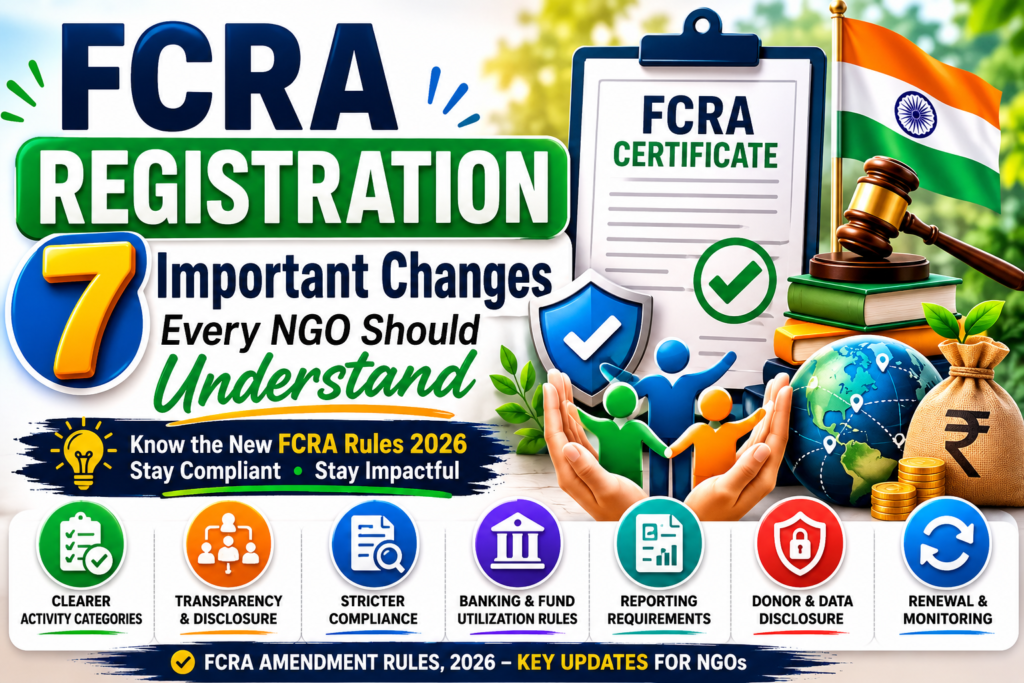
As of 2026, NGOs must also comply with the FCRA Amendment Rules, 2026, which introduce additional reporting requirements, clearer definitions of permissible activities, and enhanced transparency obligations for organizations receiving foreign contributions. These updates make it even more important for NGOs to understand the latest FCRA registration process before applying for foreign funding.
This guide explains the FCRA registration process, eligibility requirements, compliance obligations, and common mistakes NGOs should avoid.
What Is FCRA Registration?
FCRA registration is the legal authorization granted by the Government of India that allows eligible NGOs, trusts, societies, and Section 8 companies to receive foreign contributions from individuals, foundations, governments, or international organizations.
Without an FCRA certificate, an NGO cannot legally accept foreign donations or grants.
Why Is FCRA Registration Important?
Obtaining FCRA registration offers several benefits:
- Legally receive foreign funding
- Build credibility with international donors
- Access global grants and development programs
- Strengthen long-term sustainability
- Ensure compliance with Indian regulations
Many international agencies require organizations to hold a valid FCRA certificate before funding projects.
Who Can Apply for FCRA Registration?
Organizations eligible for FCRA registration include:
- Registered Trusts
- Registered Societies
- Section 8 Companies
To qualify, an organization generally should:
- Be legally registered in India.
- Have undertaken reasonable charitable activities.
- Maintain proper financial records.
- Demonstrate genuine social, educational, cultural, religious, or economic objectives.
Organizations that do not yet meet the eligibility requirements may explore obtaining prior permission for receiving a specific foreign contribution, subject to applicable regulations.
Documents Required for FCRA Registration
The FCRA registration process typically requires:
- Registration certificate of the NGO
- PAN card
- Trust Deed, Memorandum of Association, or Articles of Association
- Audited financial statements
- Activity reports
- Details of office bearers
- Aadhaar or Passport of key functionaries
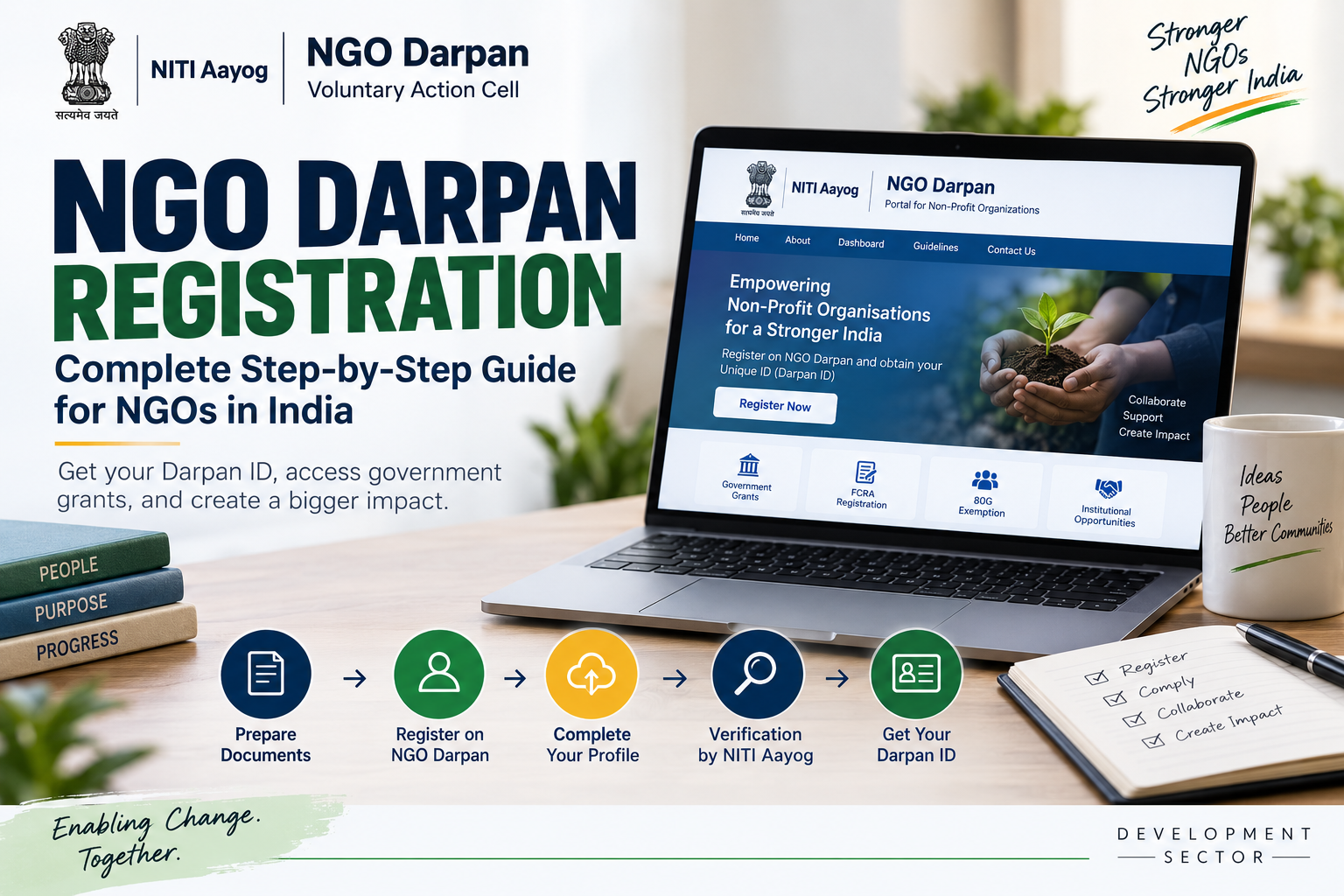
- DARPAN ID (where applicable)
- Dedicated FCRA bank account in the designated branch prescribed under current rules
Preparing complete documentation helps reduce delays during processing.
Step-by-Step FCRA Registration Process
Step 1: Register Your NGO
Before applying for FCRA registration, your organization must first be legally registered as a Trust, Society, or Section 8 Company.
Step 2: Open an FCRA Bank Account
Organizations must open the designated FCRA bank account required under current regulations before receiving foreign contributions.
Step 3: Prepare Supporting Documents
Collect all required legal, financial, governance, and organizational documents.
Step 4: Submit the Online Application
The application for FCRA registration is submitted through the Ministry of Home Affairs (MHA) online portal along with the prescribed fee and supporting documents.
Step 5: Government Verification
Authorities review the application, verify documents, and may conduct additional due diligence before making a decision.
Step 6: Grant of FCRA Certificate
If approved, the NGO receives its FCRA certificate, allowing it to legally receive foreign contributions in accordance with applicable laws.
NGO Compliance After FCRA Registration
Receiving an FCRA certificate is only the beginning. NGOs must continue complying with various legal requirements.
Important compliance obligations include:
- Maintain separate books of accounts for foreign contributions.
- Use foreign funds only for approved charitable purposes.
- File mandatory annual returns within prescribed timelines.
- Maintain transparency in fund utilization.
- Keep accurate records of all foreign contributions and expenditures.
- Comply with applicable provisions of the Foreign Contribution (Regulation) Act and related rules.
Failure to comply may result in penalties or suspension of registration.
Common Reasons for Application Delays
Many organizations experience delays because of:
- Incomplete documentation
- Incorrect application details
- Weak financial records
- Governance-related inconsistencies
- Non-compliance with eligibility requirements
Carefully reviewing the application before submission can significantly improve the chances of successful approval.
Common Mistakes NGOs Should Avoid
Some common mistakes include:
- Applying before meeting eligibility requirements
- Maintaining incomplete financial records
- Using foreign contributions for unauthorized purposes
- Missing annual compliance deadlines
- Failing to update organizational information with authorities
Good governance practices help organizations remain compliant over the long term.
FCRA Registration vs Prior Permission
Organizations often confuse FCRA registration with prior permission.
FCRA Registration is generally intended for eligible organizations seeking to receive foreign contributions on an ongoing basis, subject to compliance with the law.
Prior Permission allows an eligible organization to receive a specific foreign contribution from a particular donor for a defined purpose, subject to applicable approvals.
Choosing the appropriate route depends on the NGO’s circumstances and regulatory eligibility.
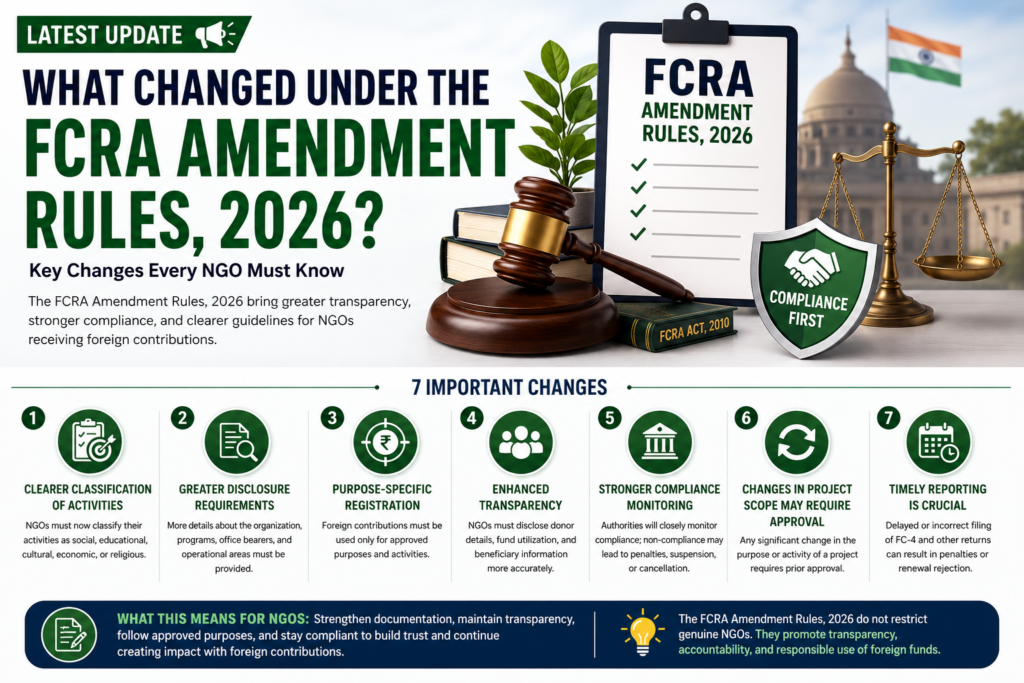
Latest Update: What Changed Under the FCRA Amendment Rules, 2026?
The Ministry of Home Affairs (MHA) notified the FCRA Amendment Rules, 2026 to strengthen transparency, improve accountability, and provide greater clarity on how NGOs can receive and utilize foreign contributions. The amendments apply not only to organizations seeking fresh FCRA registration but also to existing FCRA-registered NGOs and those applying for renewal or prior permission.
Below are some of the most significant changes and what they mean in practice.
1. NGOs Must Clearly Define Their Activities
Earlier, many organizations described their objectives broadly, such as “community development” or “social welfare.”
Under the new rules, organizations must classify their activities into clearly defined categories, such as:
- Educational
- Social
- Economic
- Cultural
- Religious
Example:
If an NGO works on girls’ education in rural areas, it should register its activities under the Educational category rather than using a broad description like “community development.” If the NGO later expands into healthcare or livelihood projects, it may need to update its approved purposes through the prescribed process.
2. Greater Clarity for Religious Activities
The 2026 Rules provide a more detailed description of what qualifies as religious activities under the FCRA framework. This includes activities such as maintaining places of worship, preserving religious literature, operating community kitchens (langars), and supporting pilgrim facilities.
Example:
A trust receiving foreign donations to restore an old temple or publish translated religious scriptures can more clearly identify these activities within the approved categories, reducing ambiguity during compliance reviews.
3. Stronger Reporting and Transparency Requirements
Organizations are expected to provide more detailed information regarding their activities, operational areas, governance, and utilization of foreign contributions.
Example:
Suppose an NGO receives ₹1 crore from an international foundation to improve sanitation in five districts. Instead of reporting only the total amount received, the NGO should maintain clear records showing:
- Which districts received funding
- How much was spent in each district
- Number of beneficiaries
- Progress of each project
- Supporting financial documents
This improves transparency for regulators and donors alike.
4. Changes in Project Scope May Require Approval
Organizations cannot significantly change the purpose for which foreign funds are received without following the prescribed procedures.
Example:
An NGO approved to receive foreign funding for education cannot later redirect the same funds toward healthcare or environmental projects without obtaining the necessary approvals where required.
This ensures that donor funds are used only for their intended objectives.
5. Increased Focus on Compliance and Monitoring
The amendments strengthen regulatory oversight by requiring organizations to maintain accurate documentation, governance records, and financial reporting.
Example:
If an NGO fails to maintain proper utilization records or submits inaccurate annual returns, it may face regulatory scrutiny, delays in renewal, or other action under the FCRA framework.
Organizations should therefore conduct regular internal audits and maintain updated compliance records throughout the year instead of waiting until the annual filing deadline.
What Do These Changes Mean for NGOs?
The FCRA Amendment Rules, 2026 do not prevent genuine NGOs from receiving foreign funding. Instead, they place greater emphasis on documentation, transparency, and accountability.
For organizations with strong governance systems, the new rules primarily require more structured reporting and clearer documentation. However, NGOs with weak financial controls or poorly documented activities may need to strengthen their compliance processes before applying for FCRA registration, renewal, or prior permission.
The key takeaway is simple: successful FCRA compliance is no longer just about receiving foreign funds—it is equally about demonstrating that every rupee is used transparently, lawfully, and for the purpose for which it was approved.
Best Practices for NGOs Receiving Foreign Funding
To maintain strong compliance and donor confidence:
- Maintain transparent financial systems.
- Conduct regular internal audits.
- Keep governance records updated.
- Train staff on FCRA compliance.
- Document project implementation carefully.
- Maintain accurate donor records.
Strong compliance systems improve both accountability and organizational credibility.
Conclusion
FCRA registration is more than just a legal requirement—it is a gateway for Indian NGOs to access international funding while maintaining transparency and accountability. With the introduction of the FCRA Amendment Rules, 2026, organizations must pay even closer attention to governance, documentation, fund utilization, and statutory compliance.
Whether you’re applying for a new FCRA registration, seeking prior permission, or renewing an existing registration, understanding the latest regulatory changes can help your organization avoid compliance issues and build long-term credibility with international donors.
Before submitting your application, ensure that your NGO has strong financial systems, clear governance practices, and a thorough understanding of the latest FCRA rules. A well-prepared organization is not only more likely to secure approval but also better positioned to create lasting social impact through responsible use of foreign contributions.
Continue Your Development Sector Journey
Looking to build a career in the social sector or stay updated on NGO policies? Explore DevelopmentSector.com for the latest NGO jobs, CSR careers, fellowships, policy insights, funding resources, and practical guides for development professionals across India.