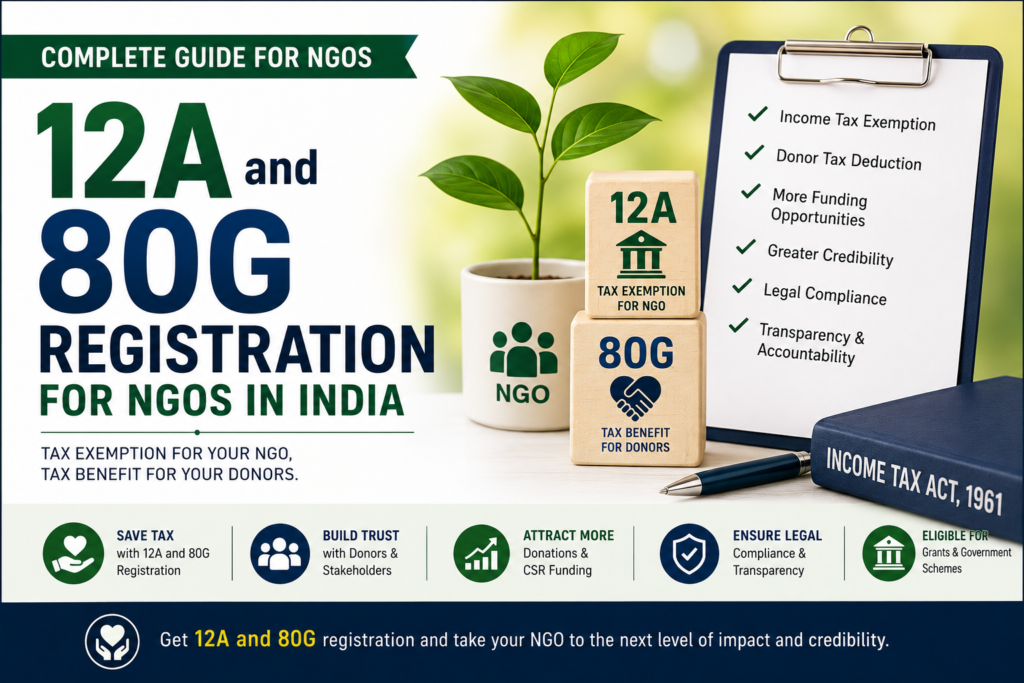
12A and 80G are among the most important tax registrations that every NGO in India should understand. While registering as a Trust, Society, or Section 8 Company gives an organization legal identity, it does not automatically provide income tax exemption or allow donors to claim tax deductions. These benefits become available only after obtaining 12A and 80G registration under the Income-tax Act, 1961.
Whether your organization works in education, healthcare, women’s empowerment, child welfare, environmental conservation, rural development, disability inclusion, or humanitarian relief, 12A and 80G registration can significantly strengthen your financial sustainability and fundraising potential.
For many corporate donors, philanthropists, grant-making organizations, and CSR partners, 12A and 80G registration serves as an indicator of credibility, transparency, and legal compliance. NGOs without these registrations may struggle to attract donations or qualify for institutional funding opportunities.
This guide explains everything you need to know about 12A and 80G, including eligibility, registration process, benefits, recent changes under the 12AB regime, common mistakes, and best practices for maintaining compliance.
What Is 12A and 80G?
Although often mentioned together, 12A and 80G serve two different purposes under the Income-tax Act.
What is 12A (Now 12AB)?
12A registration, now governed under the 12AB framework, allows eligible NGOs to claim exemption from income tax on their charitable income.
This means income generated through:
- Donations
- Grants
- Membership fees
- CSR funding
- Interest income
- Program fees
- Other charitable receipts
may remain exempt from income tax, provided the NGO complies with applicable legal requirements.
Without valid 12AB registration, surplus income may become taxable just like any other organization.
What is 80G?
Unlike 12AB, 80G benefits the donor rather than the NGO.
Individuals and companies donating to NGOs with valid 80G approval may be eligible to claim deductions on qualifying donations while filing their income tax returns, subject to the provisions of the Income-tax Act.
This makes NGOs with 12A and 80G significantly more attractive to donors because they receive both legal credibility and tax advantages.
Why Every NGO Needs 12A and 80G
Every NGO should consider obtaining 12A and 80G soon after completing its legal registration.
These registrations provide several advantages.
1. Income Tax Exemption
12AB helps NGOs legally reduce or eliminate income tax liability on eligible charitable income.
2. Donor Tax Benefits
80G allows donors to claim tax deductions, encouraging larger and more frequent donations.
3. Increased Credibility
Organizations possessing 12A and 80G are generally viewed as more trustworthy by donors, CSR partners, and funding agencies.
4. Better CSR Opportunities
Many companies prefer partnering with NGOs that already possess 12A and 80G because they demonstrate stronger compliance.
5. Improved Grant Eligibility
Several government departments, international foundations, and institutional donors prefer organizations with complete tax registrations.
6. Long-Term Sustainability
Reduced tax burden combined with improved fundraising strengthens long-term financial stability.
Eligibility for 12A and 80G
Organizations applying for 12A and 80G should generally satisfy certain conditions.
The NGO should:
- Be legally registered as a Trust, Society, or Section 8 Company.
- Operate exclusively for charitable purposes.
- Maintain proper books of accounts.
- Have clearly defined charitable objectives.
- Avoid distributing profits among members or trustees.
- Maintain transparency in financial reporting.
- Comply with applicable provisions of the Income-tax Act.
Organizations carrying out genuine charitable work are generally better positioned to obtain approval.
Who Should Apply for 12A and 80G?
Almost every nonprofit organization can benefit from 12A and 80G, including:
- Educational Trusts
- Healthcare NGOs
- Child Rights Organizations
- Women’s Empowerment NGOs
- Environmental Organizations
- Rural Development NGOs
- Disability Rights Organizations
- Animal Welfare Trusts
- CSR Implementing Agencies
- Religious and Charitable Trusts
Regardless of size, obtaining 12A and 80G improves an NGO’s ability to raise funds responsibly.
Documents Required for 12A and 80G
Before applying, NGOs should prepare the following documents.
- Registration Certificate
- PAN Card
- Trust Deed / MOA / AOA
- Address Proof
- PAN of Trustees or Directors
- Aadhaar or Identity Proof
- Bank Account Details
- Financial Statements (where applicable)
- Activity Report
- Details of Governing Body Members
Keeping documents accurate and updated reduces delays during verification.
Step-by-Step 12A and 80G Registration Process
Step 1: Register the NGO
The organization must first be legally established as a Trust, Society, or Section 8 Company.
Step 2: Obtain PAN
A Permanent Account Number (PAN) is mandatory before applying for 12A and 80G. Obtain Pan account from here.
Step 3: Open a Bank Account
Maintain a dedicated bank account for NGO transactions to ensure transparency.
Step 4: Prepare Documentation
Collect all required legal, financial, and governance documents before starting the application.
Step 5: Apply Online
Applications for 12A and 80G are submitted electronically through the Income Tax Department portal.
Applicants should ensure that all information matches their registration documents.
Step 6: Verification
Authorities may review the application and request additional documents or clarifications.
Maintaining accurate records helps speed up this process.
Step 7: Approval
After successful verification, the Income Tax Department issues the registration electronically.
The NGO can then begin enjoying the benefits of 12A and 80G while continuing to comply with applicable regulations.
Latest Changes Under the 12AB Registration Regime
One of the most significant reforms in recent years has been the transition from the old 12A registration system to the 12AB regime. Earlier, many NGOs received registrations that remained valid indefinitely. Under the revised framework, registrations are now granted for specific periods and may require renewal, depending on the organization’s status and applicable provisions.
The objective of these reforms is to improve transparency, strengthen accountability, and ensure that only genuine charitable organizations continue to receive tax benefits.
Some important changes include:
- Time-bound registration instead of perpetual approval.
- Online application through the Income Tax portal.
- Greater scrutiny of charitable activities.
- Digital verification of applications.
- Increased emphasis on financial transparency.
- Mandatory compliance with renewal requirements where applicable.
Example
Suppose an education-focused NGO received tax registration several years ago under the previous system. Under the current framework, it may need to review the validity of its registration and complete the prescribed renewal process to continue enjoying tax exemptions. Failing to renew on time could affect its tax-exempt status and donor confidence.
Benefits of 12A and 80G
Obtaining 12A and 80G offers advantages not only for NGOs but also for donors, corporate partners, and funding agencies.
Income Tax Exemption
With 12A and 80G, eligible NGOs can claim exemption on qualifying income used for charitable purposes. This allows organizations to allocate more resources toward social impact rather than taxes.
Higher Donor Confidence
Donors are more likely to support organizations that demonstrate legal compliance and financial transparency. 12A and 80G registration signals that an NGO follows recognized regulatory standards.
Better CSR Funding Opportunities
Many companies prefer to collaborate with NGOs that have completed 12A and 80G registration because it simplifies due diligence and strengthens confidence in the implementing organization.
Improved Access to Grants
Government agencies, philanthropic foundations, and international organizations often review an NGO’s legal and tax compliance before awarding grants. Having 12A and 80G strengthens eligibility for many funding opportunities.
Enhanced Public Credibility
Legal compliance improves an NGO’s reputation among beneficiaries, volunteers, financial institutions, and corporate partners.
Stronger Financial Sustainability
The combined benefits of tax exemption and improved fundraising make 12A and 80G a valuable long-term investment for any nonprofit organization.
Common Mistakes NGOs Should Avoid
Many organizations delay or lose valuable opportunities because of avoidable compliance mistakes.
Assuming NGO Registration Is Enough
One of the most common misconceptions is that registering as a Trust, Society, or Section 8 Company automatically provides tax exemptions.
In reality, 12A and 80G must be obtained separately.
An NGO registers as a Society and begins raising donations. Since it has not completed 12A and 80G registration, donors cannot claim tax benefits, making fundraising more difficult.
Delaying Applications
Some organizations wait several years before applying for 12A and 80G.
Early registration helps build credibility and simplifies future fundraising efforts.
Poor Financial Records
Maintaining incomplete accounting records, missing receipts, or inaccurate financial statements may create compliance challenges during verification.
If an NGO cannot explain how donations were utilized, authorities may seek additional clarification before approving registration.
Mixing Personal and NGO Funds
All NGO transactions should pass through dedicated organizational bank accounts.
Using personal accounts for charitable transactions reduces transparency and may create legal complications.
Deviating From Charitable Objectives
Organizations should ensure that activities remain consistent with the objectives described in their governing documents.
Significant deviations may affect compliance.
Ignoring Ongoing Compliance
Obtaining 12A and 80G is not the final step.
Organizations should continue maintaining:
- Accurate financial records
- Annual statutory filings
- Governing body documentation
- Meeting minutes
- Proper donation receipts
- Internal controls
Strong compliance protects an NGO’s long-term credibility.
Expert Tips for NGOs
To maximize the benefits of 12A and 80G, organizations should:
- Apply soon after NGO registration.
- Maintain digital accounting records from the beginning.
- Issue proper donation receipts.
- Conduct regular internal audits.
- Preserve governing body resolutions.
- Keep legal documents updated.
- Ensure financial transparency.
- Maintain activity reports and impact documentation.
- Seek professional advice before major structural or financial changes.
Good governance today helps avoid compliance challenges tomorrow.
Final Thoughts
For any nonprofit organization, 12A and 80G are more than statutory registrations—they are the foundation of financial credibility and sustainable growth.
While 12A and 80G help NGOs reduce tax liability and encourage charitable giving, they also demonstrate accountability, transparency, and responsible governance. These qualities are increasingly important for attracting CSR partnerships, institutional grants, government support, and individual donors.
Whether you are launching a new Trust, Society, or Section 8 Company, obtaining 12A and 80G should be one of your highest priorities after legal registration.
Organizations that invest in compliance today are better positioned to build donor trust, secure long-term funding, and create lasting social impact.
Continue Learning with DevelopmentSector.com
Looking to strengthen your NGO or build a career in the development sector?
Explore DevelopmentSector.com for expert guides on:
- NGO Registration in India
- FCRA Registration
- CSR-1 Registration
- CSR Policy Updates
- NGO Compliance
- Development Sector Jobs
- Fellowships
- Grants
- Internships
- Social Work Careers
Stay informed with practical insights, policy updates, and opportunities designed for changemakers across India.
Is 12A and 80G mandatory?
No. However, NGOs without 12A and 80G generally cannot claim income tax exemptions or provide eligible tax deductions to donors
Can an NGO have 12A without 80G?
Yes. The two registrations serve different purposes and are processed separately.
Can an NGO obtain 80G without 12A?
In practice, organizations seeking 80G approval are generally expected to hold the applicable income tax exemption registration under the current legal framework.
Do Section 8 Companies require 12A and 80G?
Yes. Section 8 Companies also benefit from 12A and 80G if they wish to claim tax exemptions and attract donors seeking tax deductions.
Is 12AB registration permanent?
No. Under the current regime, registrations are subject to prescribed validity periods and compliance requirements.