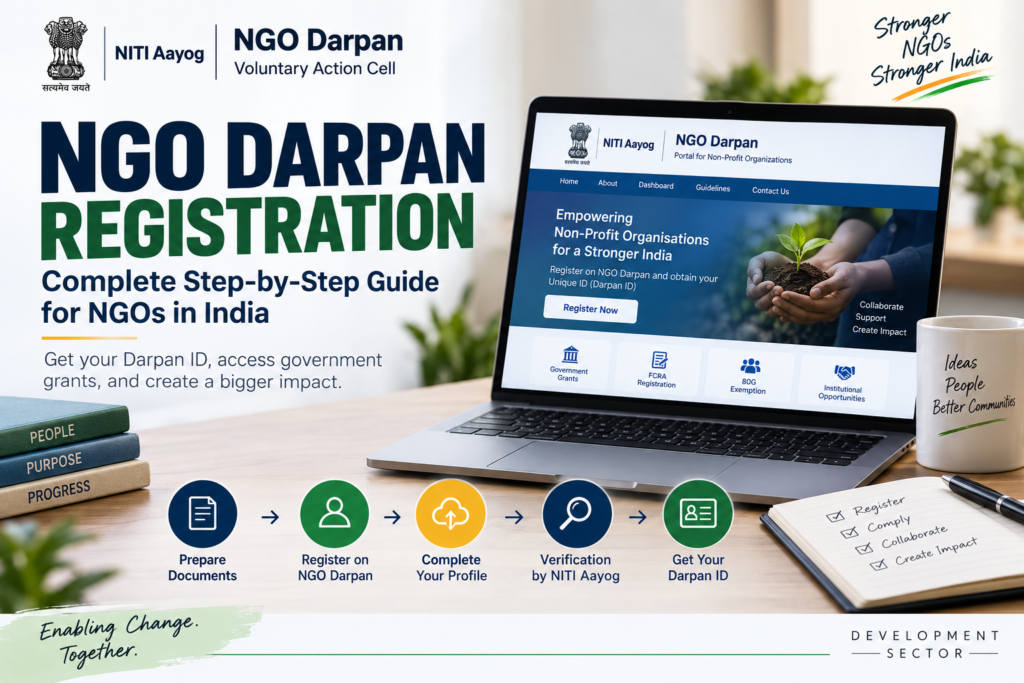
NGO Darpan registration is an important step for non-profit organisations in India that want to access government grants, schemes and other institutional opportunities.
Managed by the Voluntary Action Cell of NITI Aayog, the NGO Darpan platform enables Non-Profit Organisations (NPOs) to register and obtain a Unique Identity Number, commonly known as the Darpan ID. NITI Aayog states that the Darpan ID is mandatory for NPOs seeking grants from Government of India ministries and departments. It is also required for FCRA registration or renewal and for seeking exemption under Section 80G of the Income Tax Act.
For many organisations, however, NGO Darpan registration can seem confusing.
Is it the same as registering an NGO?
What documents are required?
How do you register on the NGO Darpan portal?
How long does verification take?
What is the NGO Darpan certificate?
And what should an organisation do after receiving its Darpan ID?
This guide explains the process in simple terms.
Important: NGO Darpan registration is different from the legal registration of an NGO as a Trust, Society or Section 8 Company. NGO Darpan provides a government-recognised identity for an already established non-profit organisation; it does not replace the underlying legal registration of the organisation.
What Is NGO Darpan?
NGO Darpan is an online platform maintained by NITI Aayog’s Voluntary Action Cell for Non-Profit Organisations.
The platform provides registered organisations with a Unique ID, allowing government departments and other institutions to identify the organisation through a standardised profile.
NITI Aayog describes the platform as enabling NPOs to register themselves and obtain a Unique Identity number called the Darpan ID.
In practical terms, an NGO can use its Darpan registration when interacting with various government grant and programme portals.
For example, government departments such as the Ministry of Tribal Affairs and the Department of Empowerment of Persons with Disabilities instruct NGOs to first register on NGO Darpan and obtain a Unique ID before applying through their respective grant portals.
Simple example
Imagine ABC Foundation is registered as a public charitable trust.
Its legal registration allows it to operate as a trust.
The organisation now wants to apply for a government grant.
Before applying through a relevant government grant portal, it may need to:
ABC Foundation → NGO Darpan registration → Darpan ID → Government grant portal → Grant application
This is why NGO Darpan registration is an important part of an NGO’s administrative setup.
Is NGO Darpan Registration the Same as NGO Registration?
No.
This is one of the most important distinctions NGOs need to understand.
An organisation can be legally established as:
- A Public Charitable Trust
- A Society
- A Section 8 Company
That is its legal structure.
NGO Darpan registration is a separate government registration/profile that provides the organisation with a Unique Darpan ID.
Think of it this way:
| Requirement | Purpose |
|---|---|
| Trust/Society/Section 8 registration | Creates the legal entity |
| PAN | Establishes tax identity |
| 12AB | Enables eligible tax exemption |
| 80G | Enables eligible donor deduction |
| FCRA | Enables eligible foreign contribution |
| NGO Darpan | Provides a Unique ID and facilitates access to government grant/programme systems |
So, registering on NGO Darpan does not mean that an organisation automatically becomes eligible for tax exemption, FCRA funding or every government grant.
Eligibility depends on the requirements of each particular law, scheme or programme.
Why Is NGO Darpan Registration Important?
There are several reasons an NGO should consider completing its Darpan registration.
1. Access to Government Grants
NITI Aayog states that Darpan ID is mandatory for NPOs seeking grants from Government of India ministries and departments.
Several government grant portals specifically instruct NGOs to register with NGO Darpan before applying.
For example, the Department of Empowerment of Persons with Disabilities requires NGOs seeking grant-in-aid under the DDRS scheme to first register on NGO Darpan and obtain a Unique ID.
2. FCRA Registration and Renewal
NITI Aayog states that the Darpan ID is also required for FCRA registration and renewal.
This makes NGO Darpan particularly important for organisations that receive or plan to receive foreign contributions.
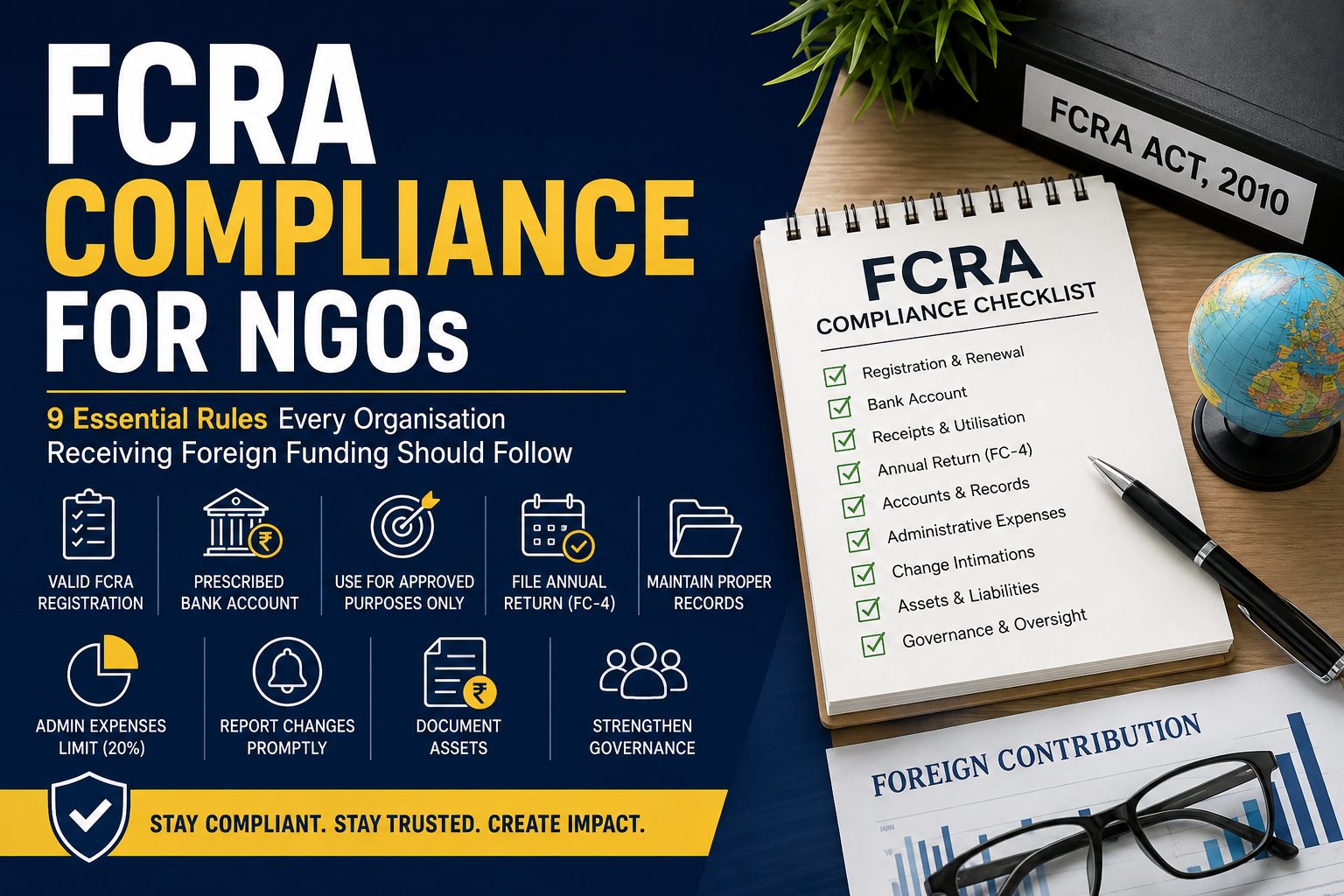
If you’re working on your organisation’s FCRA compliance, you can also read our [FCRA Compliance guide] on DevelopmentSector.
3. 80G-Related Requirements
NITI Aayog also identifies Darpan ID as a requirement for seeking exemption under Section 80G of the Income Tax Act.
NGOs should therefore consider their Darpan registration as part of their broader compliance infrastructure rather than as a standalone government profile.
4. Government Programme Applications
Many government departments have integrated NGO Darpan into their grant and programme application processes.
For example, the Ministry of Tribal Affairs’ NGO portal states that organisations must first register on NGO Darpan and obtain a Unique ID before registering on its NGO grant portal.
Similarly, the Ministry of Social Justice and Empowerment’s e-Anudaan system requires NGOs to first register on NGO Darpan and obtain an NGO Unique ID.
Who Can Register on NGO Darpan?
NGO Darpan is intended for Non-Profit Organisations (NPOs).
An organisation should first have its underlying legal identity and relevant registration documentation in place.
Depending on the organisation, this may include:
- Trust registration
- Society registration
- Section 8 company registration
- PAN of the organisation
- Governing documents
- Details of office bearers or key members
- Bank and contact information
The exact information requested can depend on the current portal requirements and the organisation’s legal structure.
Important
NGO Darpan should not be treated as a replacement for creating the NGO itself.
If you are still deciding whether your organisation should be a Trust, Society or Section 8 Company, first understand the differences between these structures.
Internal link suggestion:
Trust vs Society vs Section 8 Company
Documents and Information Required for NGO Darpan Registration
Before starting NGO Darpan registration, it is useful to keep the organisation’s information and documents ready.
The exact portal requirements can change, so organisations should always check the current requirements displayed on the official portal.
Commonly relevant information includes:
1. Organisation Name
The organisation’s name should match its official registration and PAN records.
The official NGO Darpan signup guide specifically instructs applicants to enter the NGO/entity name exactly as given on the PAN card.
2. PAN of the Organisation
The organisation’s PAN is an important part of the registration process.
The official signup instructions indicate that the PAN is entered in the subsequent signup stage and matched against the organisation/entity name entered earlier.
3. Registration Details
Keep the relevant registration certificate and registration number available.
4. Governing Documents
Depending on the legal structure, this could include:
- Trust Deed
- Memorandum of Association
- Articles of Association
- Society registration documents
- Rules and regulations/by-laws
5. Contact Details
The NGO should have access to a working:
- Mobile number
- Email address
The official signup instructions specify that the contact mobile number and email should be accessible because OTPs are sent during registration.
6. Key Members’ Details
Information about trustees, governing-body members, directors or other relevant office bearers may be required as part of completing the organisation’s profile.
7. Organisation Information
The NGO may also need information relating to:
- Address
- Objectives
- Areas of work
- Activities
- State/area of operation
- Bank details
- Website, where applicable
NGO Darpan Registration: Step-by-Step Process
Now let’s look at the NGO Darpan registration process.
Step 1: Visit the NGO Darpan Portal
Start by visiting the official NGO Darpan portal:
The official government signup instructions direct applicants to the NGO Darpan portal and the LOGIN/REGISTER option.
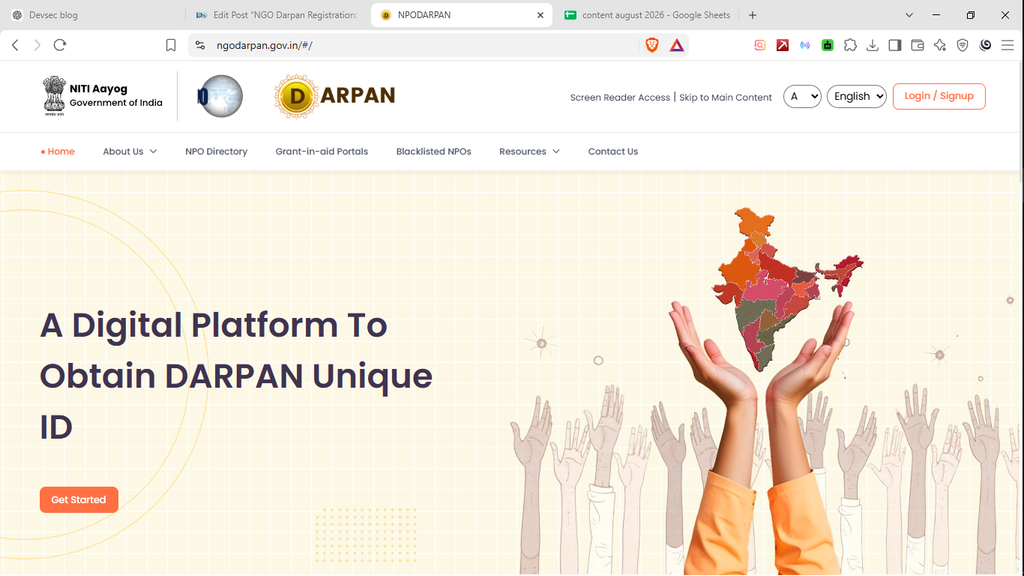
Step 2: Select Sign Up/Register
Choose the option to create a new account.
The official signup process begins with basic organisation and contact information.
You will generally need to provide:
- NGO/VO name
- Contact person’s mobile number
- Contact person’s email address
- Security/captcha code
The official guide identifies this as the first step of the three-step account creation process.
Step 3: Enter the Organisation Name Correctly
This step deserves particular attention.
The official instructions state that the NGO/entity name should be entered exactly as it appears on the PAN card.
Example
Suppose the PAN records show:
ABC DEVELOPMENT FOUNDATION
Do not casually enter:
ABC Development Foundation India
or
ABC Foundation
if that does not match the official records.
Even a small mismatch can create verification problems.
Step 4: Verify Mobile Number and Email
The registered mobile number and email address need to be accessible.
The portal uses OTP-based verification, so the person completing the registration should have access to the contact details entered.
The official Hindi signup guide also specifies that a valid mobile number and email are used to receive OTPs.
Best practice
Use an official organisational email address rather than a temporary personal email account whenever possible.
For example:
is generally easier to manage institutionally than an individual’s personal email.
Step 5: Enter the Organisation’s PAN
The next stage requires the organisation’s PAN.
According to the official signup instructions, the PAN is matched with the organisation/entity name entered in Step 1.
This is why the following information should be checked before beginning:
PAN name ↔ NGO Darpan name ↔ Legal registration name
If these records contain unexplained differences, resolve the discrepancy before proceeding wherever possible.
Step 6: Create Your Password
The official NGO Darpan signup guide describes password creation as the third stage after successfully completing the PAN verification stage.
Create a strong password and store it securely.
Do not share the login credentials casually with multiple people.
For larger NGOs, it is better to establish an internal process for managing portal credentials.
Step 7: Complete the NGO Profile
Creating the login account is not necessarily the end of the registration process.
The NGO should complete its profile and provide the required organisational information and documents.
This can include information relating to:
- Organisation registration
- Governing documents
- Office bearers
- Activities
- Objectives
- Contact information
- Address
- PAN
- Bank information
- Other required details
The official NGO Darpan guide states that once the account/profile is 100% complete, documents are verified by the portal administrator. If the documents are found to be in order, an email is sent to the applicant and the applicant can then sign in and generate the Unique ID.
How Long Does NGO Darpan Verification Take?
The official NGO Darpan signup guide says that after the profile is complete and documents are verified, an email is sent to the applicant within 48 hours when the documents are found in order, informing them that they can generate their Unique ID.
However, NGOs should not treat 48 hours as a guaranteed turnaround for every application.
Verification may depend on:
- Completeness of the profile
- Accuracy of information
- Document quality
- Any discrepancy in organisational information
- Portal or administrative processing
Therefore, it is better to complete the registration well before a government grant deadline.
What Is the NGO Darpan Unique ID?
Once the organisation successfully completes the process, it can generate its Unique NGO Darpan ID.
This ID serves as the organisation’s unique identity on the Darpan system.
The ID may then be required when registering with different government portals.
For example, the Department of Social Justice and Empowerment’s e-Anudaan portal requires the NGO Unique ID and PAN during registration, while some organisational information can be automatically populated from NGO Darpan.
What Is the NGO Darpan Certificate?
People often search for “NGO Darpan certificate”, but it is useful to understand the terminology.
The most important outcome of the Darpan registration process is the organisation’s Unique ID and completed profile.
Government departments may ask an NGO to provide proof of its Darpan registration or Unique ID as part of a grant application.
For example, government application forms can specifically request an organisation’s Darpan registration certificate or Darpan ID.
Therefore, after completing registration, NGOs should keep their Darpan-related records safely with their other statutory documents.
What Can an NGO Do After Getting Its Darpan ID?
Getting the Unique ID is only the beginning.
An NGO can then use the Darpan identity for relevant government processes where it is required.
Potential uses include:
Government Grants
Many government grant portals require Darpan registration before an NGO can submit a grant application.
FCRA Processes
NITI Aayog identifies Darpan ID as a requirement for FCRA registration and renewal.
80G-Related Processes
NITI Aayog also identifies the Darpan ID in connection with seeking 80G exemption.
Other Government Portals
Some ministries use Darpan information as part of their own NGO registration and grant processes.
This means NGOs should maintain their Darpan profile accurately and keep information updated.
NGO Darpan and Government Grants
One of the biggest practical benefits of NGO Darpan registration is its relationship with government funding.
Consider an NGO working with persons with disabilities.
If the organisation wants to apply under a government grant programme, the relevant ministry may require the NGO to:
1. Register on NGO Darpan
↓
2. Obtain Unique Darpan ID
↓
3. Register on the department’s grant portal
↓
4. Submit the grant application
↓
5. Complete scheme-specific verification
The Department of Empowerment of Persons with Disabilities follows this broad structure for its DDRS grant process.
However, having a Darpan ID does not guarantee grant approval.
Each government scheme can have its own eligibility criteria, experience requirements, documents, financial conditions and programme requirements.
Common NGO Darpan Registration Mistakes
1. Name Mismatch
One of the most avoidable problems is entering an organisation name that does not match the PAN.
The official signup instructions specifically emphasise matching the NGO/entity name with the PAN record.
2. Using an Inactive Mobile Number
If OTPs are required, the organisation needs access to the registered mobile number.
3. Using an Unmonitored Email Address
If important verification communication reaches an email account nobody checks, the NGO may miss an important notification.
4. Uploading Incorrect Documents
Before uploading documents, check:
- Organisation name
- Registration number
- Dates
- Signatures
- Legibility
- File format
- Consistency with other records
5. Leaving the Profile Incomplete
Creating an account is not the same as completing the organisation’s profile.
The official guide specifically refers to the profile being 100% complete before document verification.
6. Registering Multiple Accounts Unnecessarily
Some government grant systems explicitly warn NGOs against maintaining multiple registration accounts.
For example, e-Anudaan states that NGOs that have registered multiple times can select one account to remain active, while other accounts are deactivated.
7. Treating Darpan as a Grant Approval
Darpan registration provides an identity and facilitates access to relevant government systems.
It does not mean:
“The government has approved our NGO for funding.”
Grant eligibility and approval remain dependent on the individual scheme.
How to Keep Your NGO Darpan Profile Updated
NGOs should treat their Darpan profile as an important organisational record.
If the organisation changes information such as:
- Registered address
- Contact details
- Key members
- Activities
- Governing information
- Other organisational details
the NGO should check whether the corresponding Darpan profile needs to be updated.
This is particularly important because other government portals may use information from Darpan.
For example, e-Anudaan states that when NGO registration details need to be updated there, the information should first be updated on NGO Darpan.
Recommended internal practice
Assign one person in the organisation to monitor:
Darpan profile → Government portals → Grant applications → Compliance records
This prevents information from becoming inconsistent across different systems.
NGO Darpan Registration Checklist
Before starting the application, use this checklist:
Organisation
☐ Legal registration completed
☐ Organisation’s official name confirmed
☐ Registration number available
☐ PAN available
Contact
☐ Working mobile number
☐ Working organisational email
☐ OTP access available
Documents
☐ Registration certificate
☐ Trust Deed/MOA/Articles/by-laws, as applicable
☐ PAN documentation
☐ Governing-body/member information
☐ Other documents requested by the portal
Application
☐ Name matches PAN
☐ PAN information verified
☐ Profile completed
☐ Documents uploaded correctly
☐ Information reviewed before submission
After Registration
☐ Verification email monitored
☐ Darpan ID generated
☐ Darpan ID securely recorded
☐ Proof of registration retained
☐ Relevant government grant portals updated
NGO Darpan vs Other NGO Registrations
It is useful to understand where Darpan fits into an NGO’s overall compliance structure.
| Registration/Requirement | Main Purpose |
|---|---|
| Trust/Society/Section 8 | Legal establishment of NGO |
| PAN | Tax and financial identity |
| NGO Darpan | Unique NPO identity and government programme access |
| 12AB | Eligible income-tax exemption |
| 80G | Eligible donor tax deduction |
| FCRA | Eligible receipt and utilisation of foreign contribution |
| CSR-1 | Registration for eligible CSR implementing agencies |
These registrations are not interchangeable.
An NGO may need several of them depending on its activities, funding sources and objectives.
For example:
Legal registration → PAN → NGO Darpan → 12AB/80G → CSR-1/FCRA where applicable
The exact sequence can vary depending on the organisation and the legal requirements applicable to it
What NGOs Should Do After NGO Darpan Registration
Once your organisation receives its Darpan ID, don’t simply save the number and forget about it.
Instead:
1. Record the ID
Keep the Darpan ID in your organisation’s statutory/compliance folder.
2. Update Relevant Portals
If you’re applying through a government grant portal, enter the Darpan ID wherever required.
3. Keep Information Consistent
Make sure your:
PAN → registration certificate → Darpan → bank records → FCRA → 12AB/80G
contain consistent organisational information wherever applicable.
4. Monitor Government Opportunities
Darpan registration can make your organisation eligible to participate in relevant government grant processes, but each scheme must still be assessed individually.
5. Keep Documents Ready
Grant applications often require more than just the Darpan ID.
Government departments may request registration certificates, governing documents, annual reports, audited statements, executive committee details, PAN and other information.
Conclusion
NGO Darpan registration is an important administrative step for NGOs and other non-profit organisations operating in India.
It provides an organisation with a Unique Darpan ID and connects its institutional identity with a growing number of government grant and programme systems.
For NGOs seeking Government of India grants, the importance is particularly clear: NITI Aayog states that Darpan ID is mandatory for NPOs seeking grants from central ministries and departments. It is also required for FCRA registration or renewal and for seeking 80G exemption.
However, NGOs should remember that Darpan registration is not the same as NGO registration.
It does not replace Trust, Society or Section 8 registration. It does not automatically provide 12AB, 80G or FCRA approval. Instead, it forms an important part of the wider compliance and funding ecosystem for non-profit organisations.
The best approach is simple:
Register correctly → Complete the profile → Verify documents → Generate the Darpan ID → Keep information updated → Use it for eligible government processes.
For an NGO planning to pursue government grants, institutional funding or broader compliance, completing the Darpan registration early can help avoid unnecessary delays later.