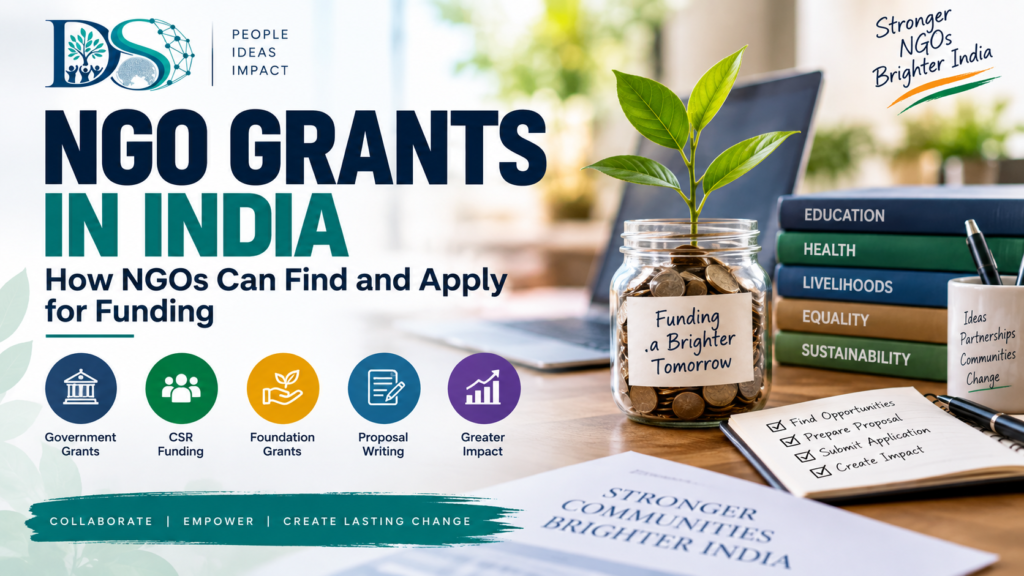
Finding sustainable funding is one of the biggest challenges for NGOs in India. Whether an organisation works in education, healthcare, livelihoods, women’s empowerment, disability, environment, child welfare or community development, a strong funding strategy is essential for turning projects into long-term impact.
An NGO grant is financial support provided to an organisation for implementing a specific programme, project or set of activities. Grants can come from government ministries and departments, corporate CSR programmes, foundations, philanthropic organisations and other institutional donors.
For NGOs looking for NGO grants in India, the first step is not simply finding a donor. The organisation must understand its eligibility, maintain proper documentation, identify funding opportunities that match its work and submit a strong proposal.
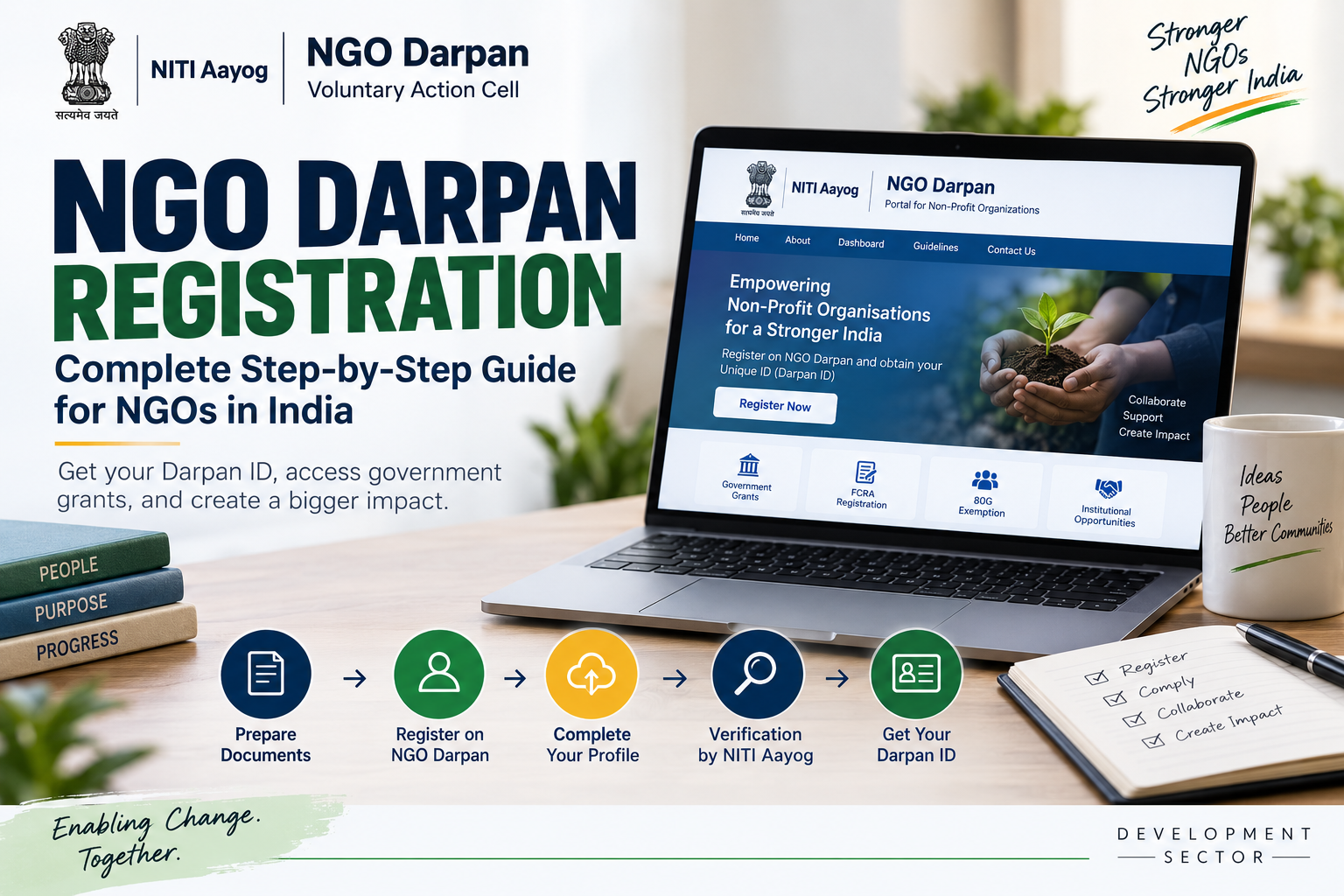
Government funding is also an important source of support. NITI Aayog states that the NGO Darpan Unique ID is mandatory for NPOs seeking grants from Government of India ministries and departments.
This guide explains how NGOs can identify NGO funding opportunities, prepare applications and improve their chances of receiving grants.
What Is an NGO Grant?
An NGO grant is financial assistance provided to a nonprofit organisation to support an eligible programme, project or institutional activity.
Unlike a conventional loan, a grant generally does not work like borrowed capital that has to be repaid. However, grants normally come with conditions related to:
- Eligible activities
- Approved budgets
- Project implementation
- Reporting
- Utilisation of funds
- Monitoring and evaluation
- Financial documentation
- Outcome reporting
The exact conditions depend on the donor and funding programme.
For example, government grant programmes may require NGOs to register on a designated portal, submit prescribed documents, undergo verification and provide utilisation and progress reports.
The Government of India’s e-Anudaan platform, for example, provides online submission and processing of NGO grant-in-aid proposals, including verification, scrutiny, recommendations, financial approval and grant sanction.
Why NGO Funding Is Important
For many organisations, donations from individuals are not enough to sustain large-scale programmes.
Institutional NGO funding can help organisations:
- Expand existing programmes
- Reach more beneficiaries
- Hire project staff
- Purchase equipment and materials
- Conduct community programmes
- Build monitoring and evaluation systems
- Develop training programmes
- Support research and advocacy
- Establish long-term projects
- Strengthen organisational capacity
However, receiving a grant also creates responsibility.
An NGO must be able to demonstrate that the funding was used for its approved purpose and that the project generated meaningful results.
7 Ways to Find NGO Grants in India
1. Look for Government Grants for NGOs
Government departments and ministries are an important source of grants for NGOs in India.
Different ministries operate different schemes depending on their objectives.
For example, the Ministry of Social Justice and Empowerment provides schemes covering areas such as Scheduled Caste welfare, social defence, welfare of backward classes and empowerment of persons with disabilities.
The e-Anudaan platform currently supports multiple grant-in-aid schemes, including programmes related to:
- Disability rehabilitation
- Senior citizens
- Drug demand reduction
- Livelihood and enterprise
- Scheduled Caste welfare
- Other welfare programmes
NGOs should therefore identify government departments whose programmes closely match their area of work.
Examples
| NGO Focus Area | Potential Government Funding Area |
|---|---|
| Disability | Rehabilitation and assistive support |
| Senior citizens | Elderly welfare |
| Livelihoods | Skill development and enterprise |
| Drug prevention | Substance-use prevention |
| Tribal welfare | Education, health and livelihoods |
| Education | School and learning programmes |
| Social welfare | Marginalised communities |
Important: Eligibility, application windows and documentation vary by scheme. NGOs should always check the current official guidelines before applying.
Also Read: NGO Darpan Registration: 7 Easy Steps to Get Your NGO Darpan ID in India
2. Use NGO Darpan to Access Government Funding Opportunities
For NGOs interested in government grants, NGO Darpan is an important starting point.
NITI Aayog’s Voluntary Action Cell maintains the NPO Darpan portal. According to NITI Aayog, the Darpan ID is mandatory for NPOs seeking grants from Government of India ministries and departments.
The Darpan ID is therefore more than a profile listing. It can be an important part of an NGO’s funding-readiness process.
NGO Darpan can help an organisation:
- Establish its profile with the government system
- Obtain its Unique ID
- Apply through government grant platforms where required
- Access ministry-specific funding processes
- Support FCRA-related requirements
- Support other compliance requirements
For example, the Ministry of Social Justice and Empowerment states that an NGO must first register on NGO Darpan and obtain its Unique ID before registering on its e-Anudaan portal.
Similarly, NGOs applying under the Deendayal Divyangjan Rehabilitation Scheme must first register with NGO Darpan and obtain a Unique ID before applying through e-Anudaan.
3. Explore Ministry-Specific NGO Funding Opportunities
One common mistake NGOs make is searching only for the phrase “NGO grant.”
Many funding opportunities are published under the name of a specific scheme or ministry.
For example, the Ministry of Tribal Affairs operates an NGO Grants Portal for programmes involving the welfare of Scheduled Tribes. Its portal provides information on schemes, application formats, annual reports and project timelines.
An NGO working in tribal education, healthcare or livelihoods should therefore monitor the Ministry of Tribal Affairs rather than searching only for generic NGO grants.
A better search strategy
Instead of searching:
NGO grant India
Try searches such as:
Government grant for education NGOs India
NGO grants for disability projects
Tribal welfare NGO grants India
Government funding for livelihood NGOs
NGO grants for senior citizens
Government grants for women empowerment NGOs
This approach helps NGOs find opportunities that are actually relevant to their programmes.
4. Look for Corporate CSR Funding
Corporate Social Responsibility is another major source of institutional funding for eligible NGOs.
Companies can support social-impact projects through CSR programmes, subject to the applicable provisions of the Companies Act and CSR Rules.
An NGO seeking corporate funding should understand the requirements for acting as a CSR implementing agency.
The Ministry of Corporate Affairs’ CSR FAQ explains the categories of entities that may act as implementing agencies, including eligible Section 8 companies, registered public trusts and registered societies meeting the applicable requirements.
What CSR funders generally look for
Corporate funders may evaluate:
- Registration status
- Governance
- Track record
- Programme design
- Beneficiary reach
- Financial controls
- Impact measurement
- Leadership
- Geographic presence
- Compliance
- Monitoring and reporting systems
Having a good cause is important, but an NGO must also demonstrate that it can responsibly implement the proposed project.
5. Search for Foundation and Philanthropic Grants
Not all NGO funding opportunities come from government or corporations.
Foundations, philanthropic organisations and institutional donors can also provide grants to nonprofits.
These funders may focus on specific themes such as:
- Education
- Public health
- Climate change
- Gender equality
- Livelihoods
- Child protection
- Disability inclusion
- Digital inclusion
- Rural development
- Poverty reduction
- Human rights
- Research and advocacy
The important point is donor alignment.
If a funder primarily supports climate projects, submitting a proposal for an unrelated education programme is unlikely to be effective.
Before applying, study:
- What the funder supports
- Where it operates
- Who can apply
- Typical grant size, if disclosed
- Application process
- Previous projects supported
- Reporting requirements
6. Monitor Official Grant Portals and Announcements
Funding opportunities can have specific application windows.
For example, the Ministry of Tribal Affairs’ NGO Grants Portal publishes timelines for applications and project processing. The portal currently lists revised timelines for ongoing NGO projects for FY 2026–27.
Similarly, the Ministry of Social Justice and Empowerment publishes information about its schemes and grant-in-aid programmes through its official platforms.
NGOs should therefore create a simple funding-monitoring system.
Maintain a funding calendar
| Information | What to Track |
|---|---|
| Funder | Ministry, company, foundation |
| Scheme | Name of funding programme |
| Focus area | Education, health, livelihood, etc. |
| Geography | States/districts covered |
| Eligibility | Who can apply |
| Opening date | Application start |
| Closing date | Application deadline |
| Documents | Required attachments |
| Grant size | If disclosed |
| Status | Researching / Applying / Submitted |
This prevents organisations from missing important deadlines.
7. Build Relationships Before You Need Funding
Grant fundraising should not begin only when an organisation urgently needs money.
Strong NGOs build relationships with potential funders over time.
This can include:
- Attending development-sector events
- Participating in consultations
- Sharing impact reports
- Publishing programme results
- Connecting with CSR teams
- Networking with foundations
- Building relationships with sector experts
- Maintaining a professional website
- Sharing credible organisational information
The objective is not to repeatedly ask for money.
The objective is to make the organisation visible, credible and relevant to potential funders.
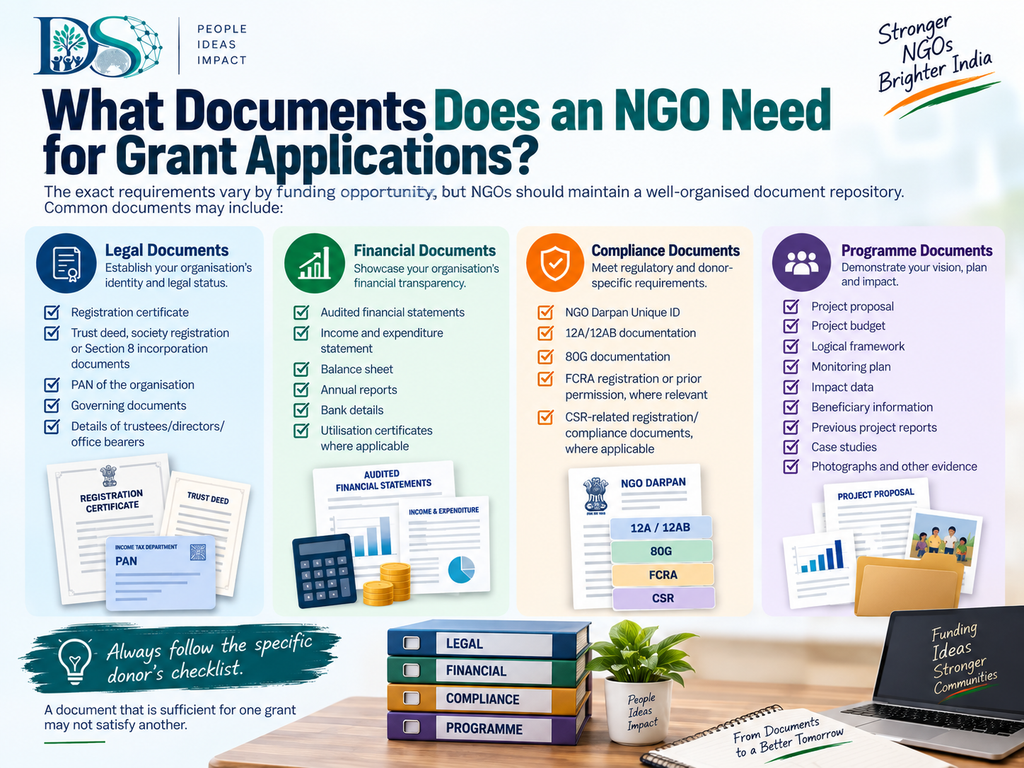
What Documents Does an NGO Need for Grant Applications?
The exact requirements vary by funding opportunity, but NGOs should maintain a well-organised document repository.
Common documents may include:
Legal Documents
- Registration certificate
- Trust deed, society registration or Section 8 incorporation documents
- PAN of the organisation
- Governing documents
- Details of trustees/directors/office bearers
Financial Documents
- Audited financial statements
- Income and expenditure statement
- Balance sheet
- Annual reports
- Bank details
- Utilisation certificates where applicable
Compliance Documents
Depending on the funding source and eligibility:
- NGO Darpan Unique ID
- 12A/12AB documentation
- 80G documentation
- FCRA registration or prior permission, where relevant
- CSR-related registration/compliance documents, where applicable
Programme Documents
- Project proposal
- Project budget
- Logical framework
- Monitoring plan
- Impact data
- Beneficiary information
- Previous project reports
- Case studies
- Photographs and other evidence
Always follow the specific donor’s checklist. A document that is sufficient for one grant may not satisfy another.
How to Prepare a Strong NGO Grant Proposal
Finding an opportunity is only half the process.
The next step is creating a proposal that clearly explains why the project deserves funding.
1. Start With the Problem
Explain the problem your NGO is addressing.
Instead of writing:
Our NGO works for education.
Write something more specific:
Children in three rural blocks face limited access to supplementary learning support, resulting in learning gaps among students from low-income households.
The second statement gives the funder a clearer understanding of the issue.
2. Define the Target Beneficiaries
Clearly explain:
- Who will benefit?
- How many people will benefit?
- Where do they live?
- Why are they vulnerable?
- How were they identified?
Avoid vague statements such as “thousands of people will benefit” unless you can substantiate the number.
3. Explain Your Solution
Describe exactly what the NGO intends to do.
For example:
Programme: Rural Learning Improvement Project
Activities:
- Baseline assessment
- Community mobilisation
- Remedial classes
- Teacher training
- Learning assessments
- Parent meetings
- Endline evaluation
This gives the funder a clear picture of how money will translate into activities.
4. Create a Realistic NGO Grant Budget
A good project proposal needs a realistic budget.
Example:
| Budget Head | Estimated Amount |
|---|---|
| Project staff | ₹6,00,000 |
| Training | ₹1,50,000 |
| Learning materials | ₹1,00,000 |
| Community activities | ₹75,000 |
| Monitoring & evaluation | ₹75,000 |
| Administration | ₹50,000 |
| Total | ₹10,50,000 |
The actual budget should always be based on the donor’s eligible cost categories and funding limits.
Do not inflate costs simply because the donor has a larger budget.
A transparent and defensible budget can improve the credibility of the proposal.
5. Explain Your Expected Impact
Funders want to know what will change because of their support.
A useful framework is:
Activities → Outputs → Outcomes → Impact
For example:
Activity: Conduct remedial learning sessions
↓
Output: 500 students participate in structured sessions
↓
Outcome: Students demonstrate improved learning levels
↓
Impact: More children gain the foundational skills required to continue their education successfully
This structure makes a proposal easier to evaluate.
NGO Grant Application Process: Step by Step
Although every donor has its own process, the following framework works for many funding opportunities.
Step 1: Identify a Relevant Grant
Find an opportunity that matches your organisation’s work.
Step 2: Check Eligibility
Read the complete guidelines before investing time in the application.
Step 3: Prepare Documents
Create a folder containing legal, financial, compliance and programme documents.
Step 4: Develop the Project Concept
Define the problem, beneficiaries, activities, outcomes and budget.
Step 5: Prepare the Proposal
Follow the donor’s prescribed format.
Step 6: Submit Through the Correct Portal or Channel
Government programmes may require online submission through designated portals.
For example, e-Anudaan facilitates online submission of NGO grant proposals and subsequent processing by government authorities.
Step 7: Respond to Queries
Funders may request clarifications or additional documents.
Step 8: Verification and Review
Depending on the scheme, applications may undergo document verification, scrutiny, inspection or other evaluation.
Step 9: Grant Approval
If selected, the funder issues the applicable sanction, agreement or approval.
Step 10: Implement and Report
The NGO must use funds according to the approved purpose and comply with reporting requirements.
Common Reasons NGO Grant Applications Fail
Even a good project can be rejected if the application is poorly prepared.
1. Applying for Every Grant
More applications do not necessarily mean more funding.
Apply selectively to opportunities that genuinely match your organisation.
2. Weak Problem Statement
If the proposal does not clearly explain the problem, the funder may not understand why the project matters.
3. Unrealistic Budget
A budget that does not match the activities can reduce credibility.
4. Poor Documentation
Missing registration, financial or compliance documents can create avoidable problems.
5. No Evidence of Impact
Funders want to know what the organisation has already achieved.
Use:
- Numbers
- Case studies
- Testimonials
- Evaluation results
- Photographs
- Previous project reports
where appropriate and ethically collected.
6. Copy-Paste Proposals
A proposal written for one funder should not simply be submitted to another.
Every application should reflect the specific donor’s objectives.
7. Ignoring Guidelines
This is one of the most avoidable mistakes.
If a funder asks for a particular format, document or application channel, follow it.
Government Grants vs CSR Funding vs Foundation Grants
| Factor | Government Grants | CSR Funding | Foundation Grants |
|---|---|---|---|
| Main source | Government ministries/departments | Companies | Foundations/philanthropic organisations |
| Main focus | Government programme priorities | CSR priorities | Funder-specific priorities |
| Application | Often through designated portals/processes | Company-specific | Funder-specific |
| Competition | Can be high | High | High |
| Documentation | Usually structured | Usually structured | Varies |
| Reporting | Scheme-specific | Project-specific | Grant-specific |
| Best approach | Match government scheme | Match CSR priority | Match funder strategy |
There is no single “best” source of funding.
A strong NGO usually develops a diversified funding strategy rather than depending entirely on one donor.
How to Build an NGO Funding Strategy
Instead of treating every grant as a separate opportunity, create a yearly funding plan.
Step 1: Define Your Core Programmes
List your major programmes and their funding requirements.
Step 2: Identify Potential Funders
Create a database of:
- Government schemes
- CSR programmes
- Foundations
- Philanthropic donors
- Institutional partners
Step 3: Match Programmes With Funders
Create a simple matrix:
| Programme | Government | CSR | Foundation |
|---|---|---|---|
| Education | ✓ | ✓ | ✓ |
| Livelihood | ✓ | ✓ | ✓ |
| Disability | ✓ | ✓ | ✓ |
| Research | Sometimes | ✓ | ✓ |
| Advocacy | Scheme-dependent | Funder-dependent | Funder-dependent |
Step 4: Prepare a Funding Pipeline
Divide opportunities into:
- Researching
- Eligible
- Proposal in progress
- Submitted
- Under review
- Approved
- Rejected
This turns fundraising into a structured process rather than an occasional activity.
NGO Funding Checklist
Before applying for an NGO grant, ask:
Organisation
- Is our NGO legally registered?
- Is our PAN available?
- Is our NGO Darpan profile active and updated?
- Are governance records updated?
- Are our financial statements ready?
Programme
- Does the project match the funder’s priorities?
- Have we clearly identified the problem?
- Have we defined beneficiaries?
- Are activities measurable?
- Are expected outcomes realistic?
Budget
- Is every major cost justified?
- Does the budget follow donor rules?
- Are administrative costs within permitted limits?
- Can we track expenditure properly?
Application
- Have we checked eligibility?
- Have we followed the application format?
- Have we attached all required documents?
- Have we checked the deadline?
- Have we saved the submitted application?
NGO Grant Opportunities: Where Should NGOs Start?
A practical starting point is to monitor official government portals rather than relying entirely on third-party grant listings.
Useful starting points include:
NGO Darpan — NITI Aayog
NITI Aayog’s Voluntary Action Cell maintains NGO Darpan and states that its Unique ID is mandatory for NPOs seeking Government of India grants.
e-Anudaan — Ministry of Social Justice & Empowerment
The platform provides online registration and grant application processes for several ministry schemes.
e-Anudaan — Department of Empowerment of Persons with Disabilities
The portal facilitates NGO applications for grant-in-aid schemes including DDRS.
NGO Grants Portal — Ministry of Tribal Affairs
The portal publishes NGO grant schemes, formats and application timelines related to tribal welfare programmes.
NGOs should also monitor relevant state government departments and ministry websites for new calls, scheme guidelines and application windows.
10 Tips to Improve Your Chances of Getting NGO Funding
- Keep your NGO Darpan information updated.
- Maintain clean and organised financial records.
- Build a strong project portfolio.
- Collect credible impact data.
- Apply only to relevant funding opportunities.
- Read the complete grant guidelines.
- Create realistic project budgets.
- Use measurable outcomes.
- Submit applications before the deadline.
- Build long-term relationships with funders.
Most importantly, don’t treat grant writing as simply filling out a form.
A successful proposal connects a real problem, a credible organisation, a practical solution, a realistic budget and measurable impact.
Final Thoughts
Finding an NGO grant in India is not simply about searching for organisations willing to provide money.
Successful NGO fundraising requires preparation.
An organisation should have a clear programme, strong governance, reliable financial records, relevant compliance documents and measurable evidence of impact. It should then identify NGO funding opportunities that closely match its mission.
Government grants, CSR funding and foundation grants can all play a role in a diversified funding strategy.
For government funding, getting the basics right – particularly NGO Darpan registration, documentation and scheme eligibility—can make the process much more manageable. NITI Aayog’s current information confirms the importance of Darpan ID for NGOs seeking grants from Government of India ministries and departments.
The goal should not be to apply for every available grant.
The goal should be to find the right funder, the right programme and the right opportunity—and then demonstrate clearly why your organisation is capable of creating meaningful, measurable impact.
Frequently Asked Questions About NGO Grants in India
What is an NGO grant?
An NGO grant is financial support provided to an eligible nonprofit organisation for an approved project, programme or activity. Grants may come from government bodies, companies, foundations and philanthropic organisations.
How can NGOs get government grants in India?
NGOs can identify relevant government schemes, check eligibility, maintain required registrations and documents, and apply through the designated ministry or government grant portal. NGO Darpan registration is particularly important because NITI Aayog states that the Darpan ID is mandatory for NPOs seeking grants from Government of India ministries and departments.
Is NGO Darpan mandatory for NGO grants?
For NPOs seeking grants from Government of India ministries and departments, NITI Aayog states that the Darpan ID is mandatory. Specific schemes may also have additional requirements.
Can a new NGO apply for grants?
A new NGO may be eligible for some funding opportunities, but eligibility varies significantly by donor and scheme. Some programmes may require a specific track record, financial history, registration period or previous project experience.
What documents are required for NGO funding?
Requirements vary, but applications may ask for registration documents, PAN, financial statements, annual reports, governance information, project proposals, budgets, compliance documents and evidence of previous work.
Can NGOs receive both government and CSR funding?
Potentially, yes, depending on the applicable rules, donor conditions and whether the same project costs are being funded twice. NGOs must carefully follow the conditions of each funding source.
Where can NGOs find funding opportunities?
NGOs should monitor relevant government ministry websites, official grant portals, CSR programmes, foundations and philanthropic organisations. They should verify every opportunity against the funder’s official guidelines before applying.