
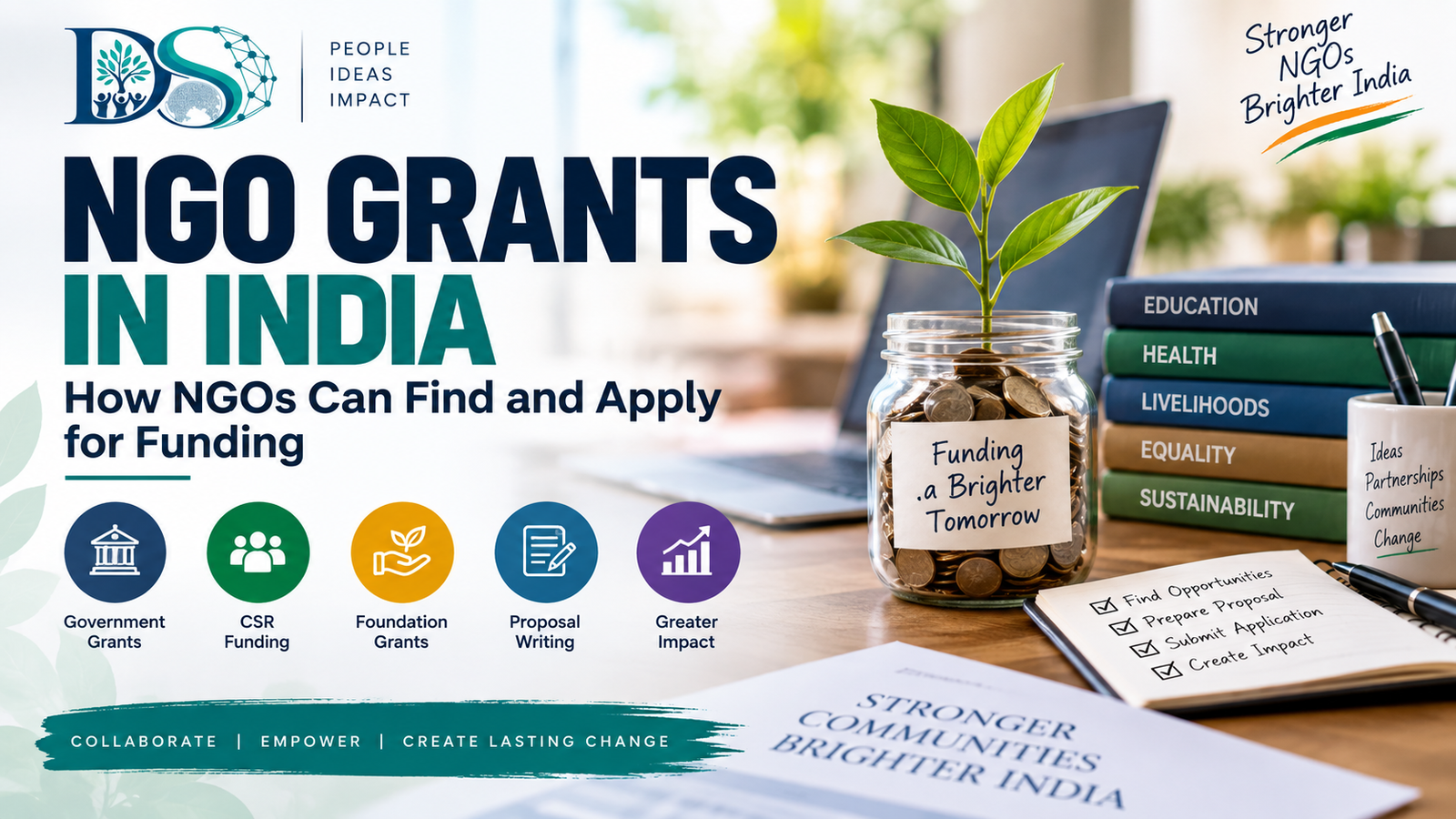
NGO Grant India: 7 Powerful Ways to Find Grants for NGOs & Get Funding
Finding sustainable funding is one of the biggest challenges for NGOs in India. Whether an organisation works in education, healthcare, livelihoods, women’s empowerment, disability, environment, child welfare or community development, a strong funding strategy is essential for turning projects into long-term impact. An NGO grant is financial support provided to an organisation for implementing a specific programme, project or set of activities. Grants can come from government ministries and departments, corporate CSR programmes, foundations, philanthropic organisations and other institutional donors. For NGOs looking for NGO grants in India, the first step is not simply finding a donor. The organisation must understand its eligibility, maintain proper documentation, identify funding opportunities that match its work and submit a strong proposal. Government funding is also an important source of support. NITI Aayog states that the NGO Darpan Unique ID is mandatory for NPOs seeking grants from Government of India ministries and departments. This guide explains how NGOs can identify NGO funding opportunities, prepare
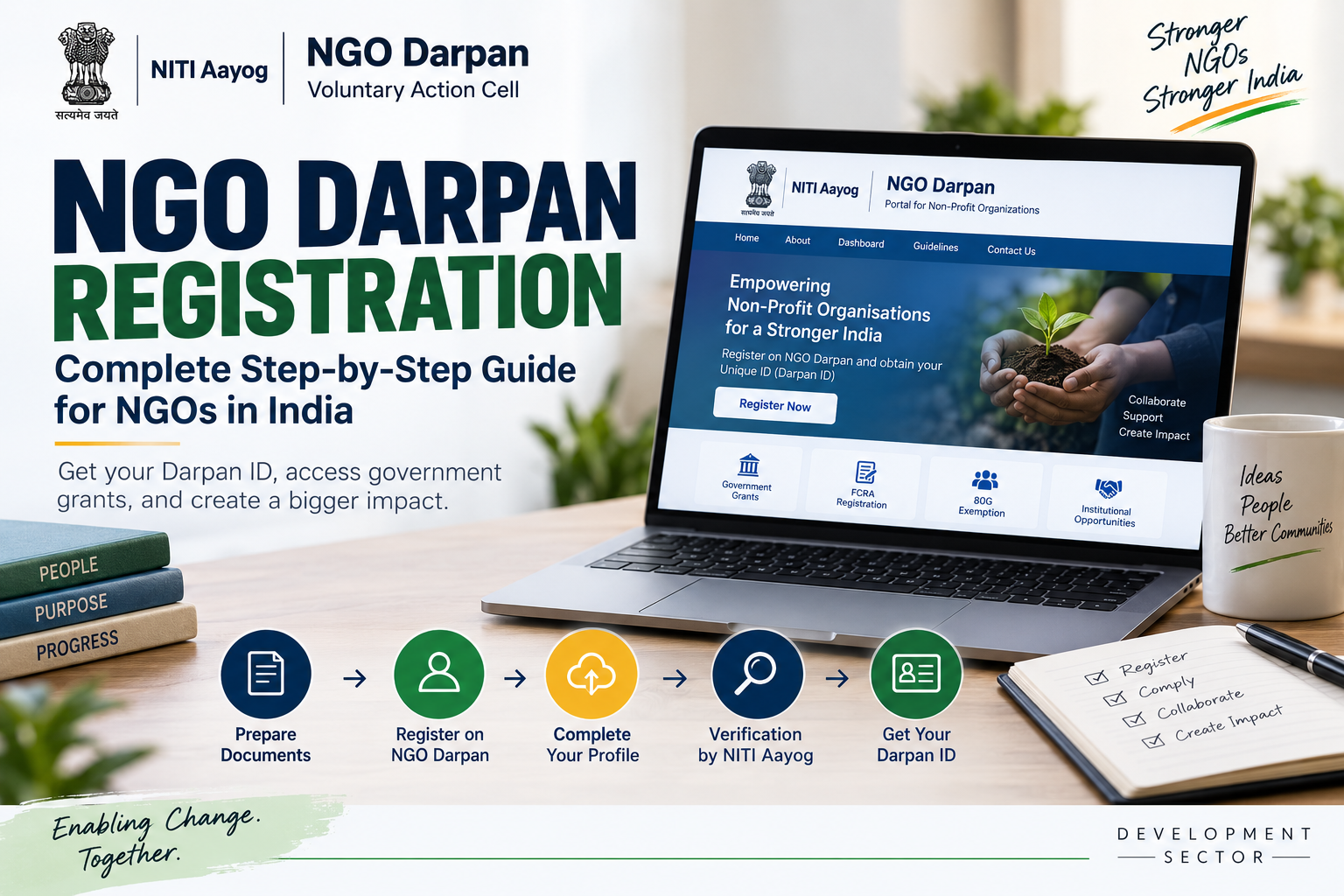
NGO Darpan Registration: 7 Easy Steps to Get Your NGO Darpan ID in India
NGO Darpan registration is an important step for non-profit organisations in India that want to access government grants, schemes and other institutional opportunities. Managed by the Voluntary Action Cell of NITI Aayog, the NGO Darpan platform enables Non-Profit Organisations (NPOs) to register and obtain a Unique Identity Number, commonly known as the Darpan ID. NITI Aayog states that the Darpan ID is mandatory for NPOs seeking grants from Government of India ministries and departments. It is also required for FCRA registration or renewal and for seeking exemption under Section 80G of the Income Tax Act. For many organisations, however, NGO Darpan registration can seem confusing. Is it the same as registering an NGO? What documents are required? How do you register on the NGO Darpan portal? How long does verification take? What is the NGO Darpan certificate? And what should an organisation do after receiving its Darpan ID? This guide explains the process in simple terms. Important: NGO Darpan registration
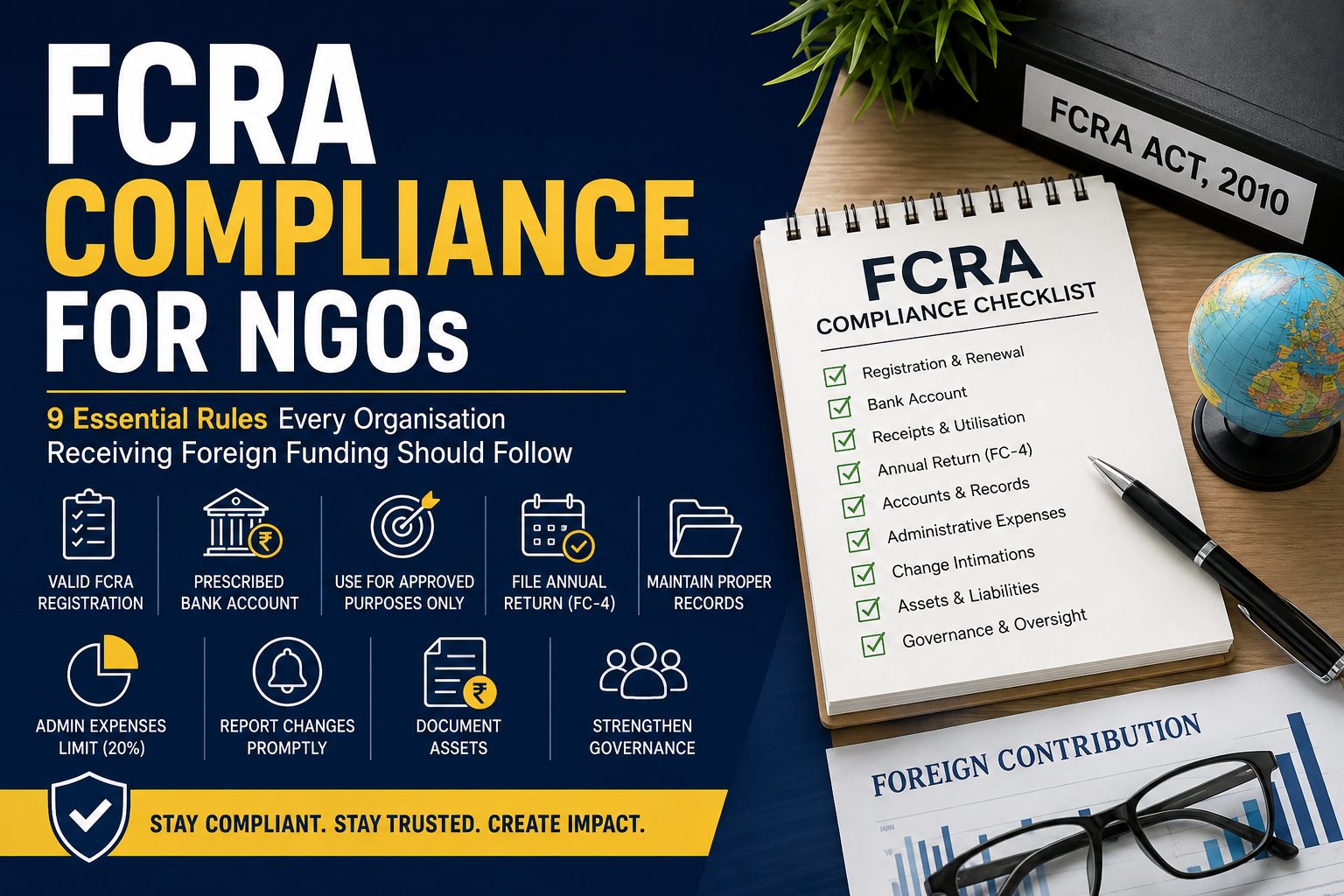
FCRA Compliance for NGOs: 9 Essential Rules Every Organisation Receiving Foreign Funding Should Follow
Receiving foreign funding can help an NGO expand its work in education, healthcare, livelihoods, humanitarian assistance, environmental protection, research and other areas of social impact. But accepting foreign contribution in India also comes with significant legal and reporting responsibilities. This is where FCRA compliance becomes essential. The Foreign Contribution (Regulation) Act, 2010, commonly known as the FCRA, regulates the acceptance and utilisation of foreign contribution and foreign hospitality in India. NGOs that receive foreign contribution must follow the Act, applicable Rules, prescribed procedures and reporting requirements. The Ministry of Home Affairs’ FCRA portal currently provides services covering registration, prior permission, renewal, annual returns, changes in registration details and other compliances. Importantly, FCRA compliance does not end when an NGO receives its FCRA certificate. An organisation must continue to demonstrate that foreign contribution is: The compliance environment has also become more detailed in 2026. The FCRA Amendment Rules, 2026, notified in June 2026, introduced activity- and State/UT-specific registration, enhanced reporting requirements
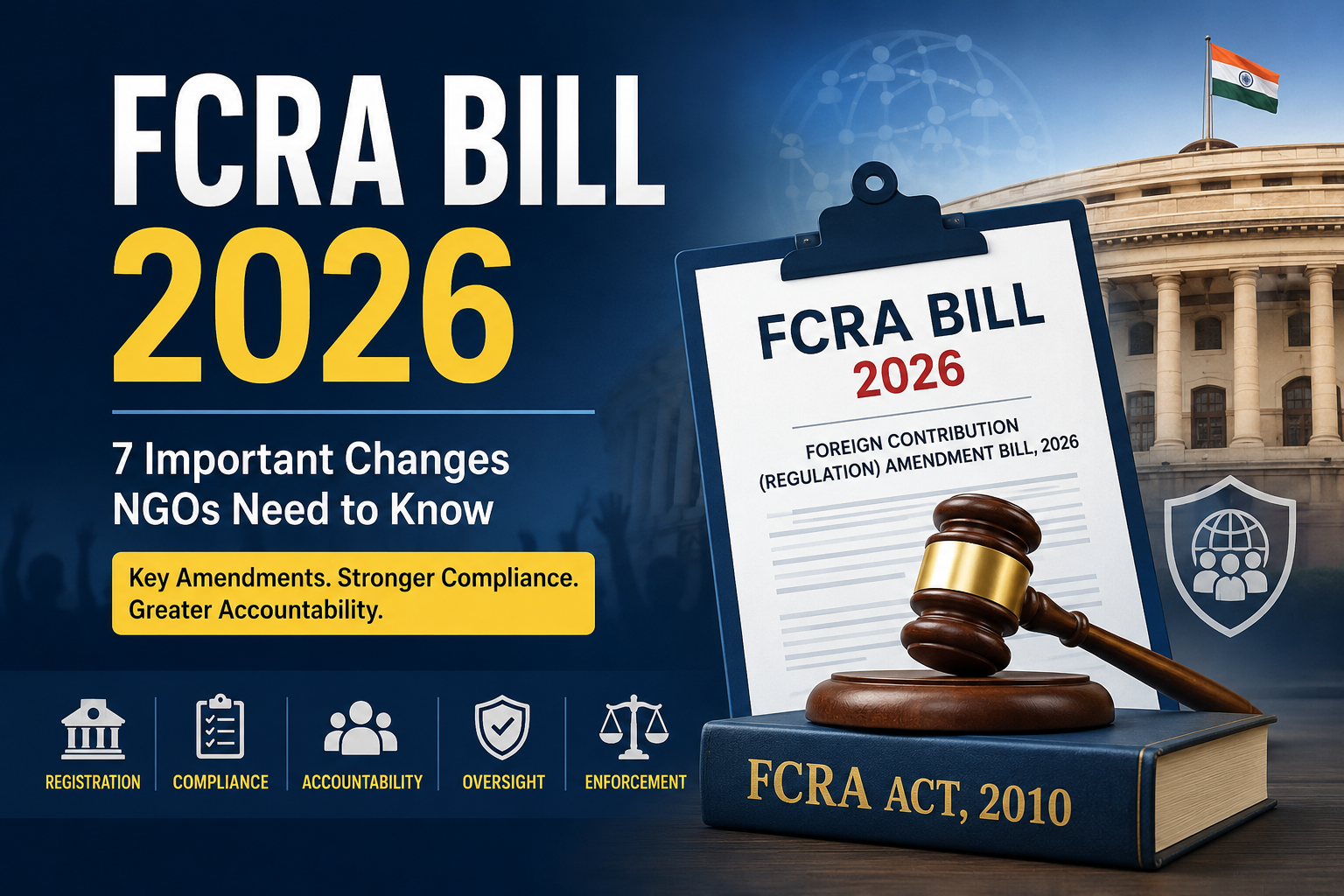
FCRA Bill 2026: 7 Important Changes NGOs in India Need to Know
The FCRA Bill 2026 marks an important development in India’s regulatory framework for organisations receiving foreign contributions. Introduced in the Lok Sabha on 25 March 2026, the Foreign Contribution (Regulation) Amendment Bill, 2026 proposes changes to the Foreign Contribution (Regulation) Act, 2010, particularly around the treatment of foreign-funded assets, cessation of FCRA registration, investigations, penalties and organisational accountability. However, there is an important distinction that NGOs should understand. The FCRA Bill 2026 is not yet law. As of 28 August 2026, it is under consideration by Parliament and was referred to a Joint Parliamentary Committee (JPC) on 12 August 2026. Therefore, the proposals discussed in this article should not be treated as current legal requirements until Parliament completes the legislative process and the provisions come into force. At the same time, another major development has already taken effect: the Foreign Contribution (Regulation) Amendment Rules, 2026 were notified on 22 June 2026 and are currently in force. These Rules introduce more
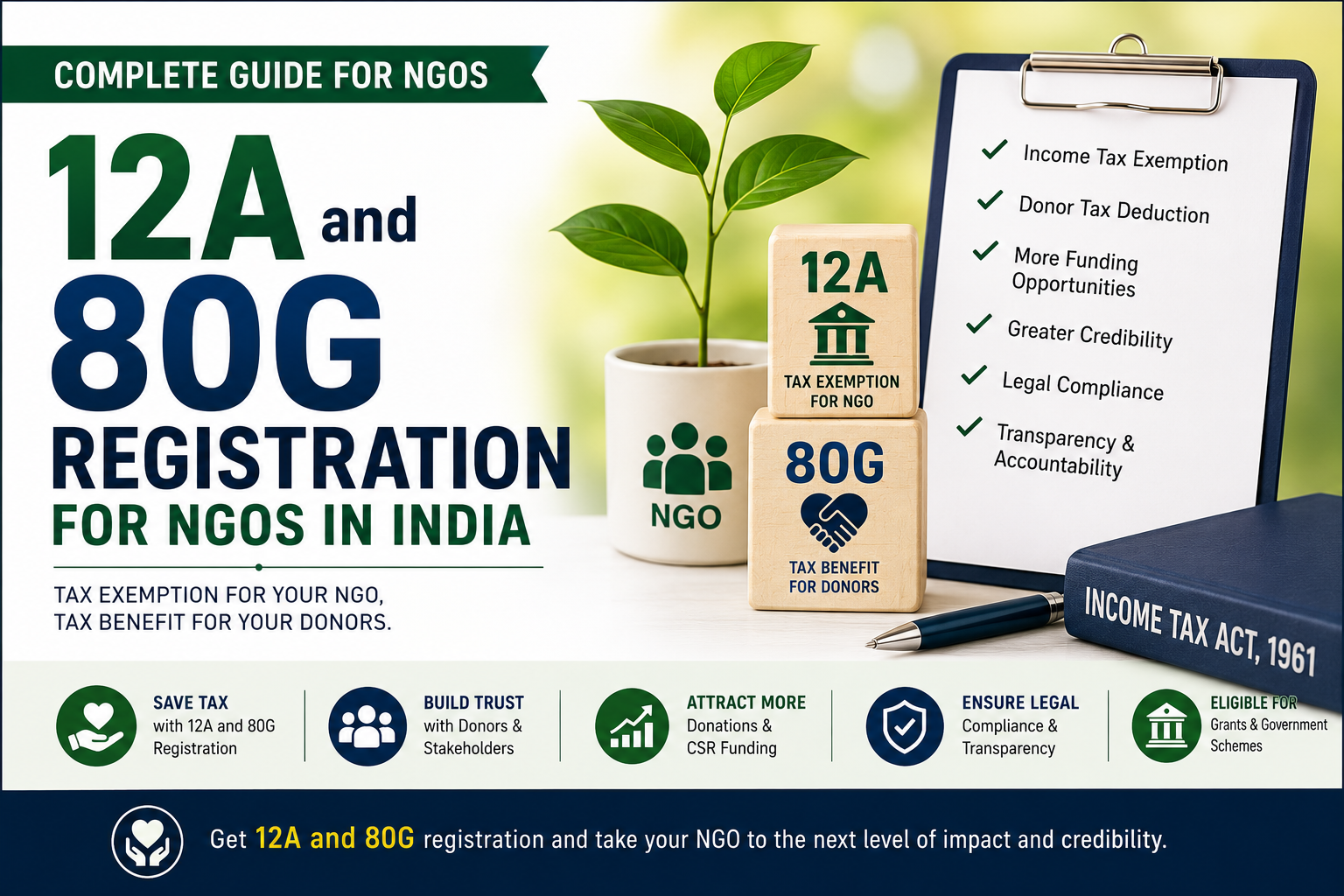
12A and 80G Registration: The Complete Guide for NGOs in India
12A and 80G are among the most important tax registrations that every NGO in India should understand. While registering as a Trust, Society, or Section 8 Company gives an organization legal identity, it does not automatically provide income tax exemption or allow donors to claim tax deductions. These benefits become available only after obtaining 12A and 80G registration under the Income-tax Act, 1961. Whether your organization works in education, healthcare, women’s empowerment, child welfare, environmental conservation, rural development, disability inclusion, or humanitarian relief, 12A and 80G registration can significantly strengthen your financial sustainability and fundraising potential. For many corporate donors, philanthropists, grant-making organizations, and CSR partners, 12A and 80G registration serves as an indicator of credibility, transparency, and legal compliance. NGOs without these registrations may struggle to attract donations or qualify for institutional funding opportunities. This guide explains everything you need to know about 12A and 80G, including eligibility, registration process, benefits, recent changes under the 12AB regime, common mistakes,
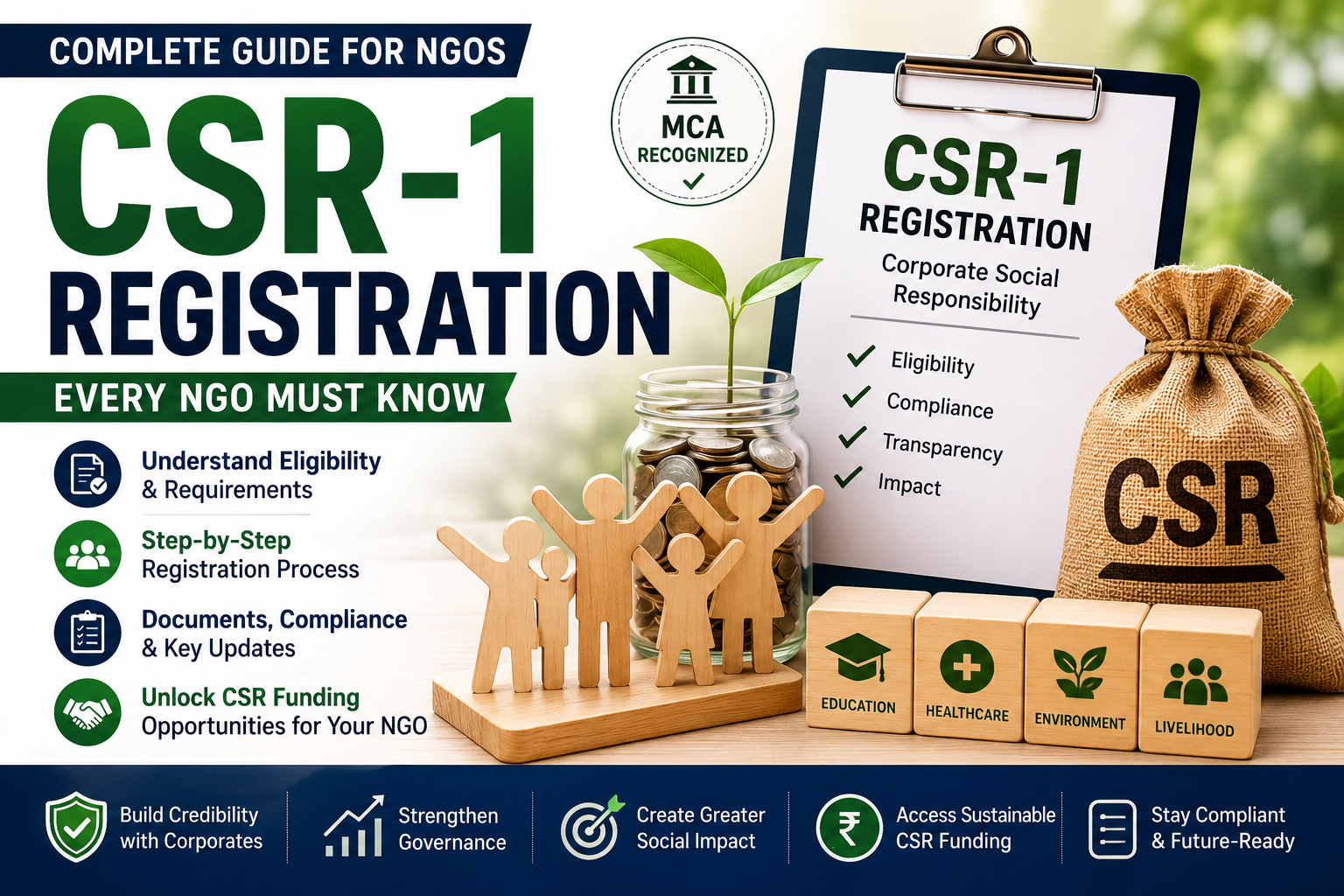
CSR-1 Registration: 7 Critical Requirements for Successful CSR Funding
Corporate Social Responsibility (CSR) has become one of the largest funding sources for NGOs in India. Every year, companies covered under Section 135 of the Companies Act invest thousands of crores in education, healthcare, environment, livelihood, and community development projects. However, to legally receive CSR funds from eligible companies, NGOs must complete CSR-1 registration. Introduced by the Ministry of Corporate Affairs (MCA), CSR-1 registration is a mandatory compliance requirement for NGOs that wish to act as implementing agencies for CSR projects. Without a valid CSR Registration Number, companies generally cannot route their CSR funds through an NGO. This guide explains what CSR-1 registration is, who can apply, eligibility criteria, required documents, the registration process, recent updates, and common mistakes NGOs should avoid. What Is CSR-1 Registration? CSR-1 registration is the process through which eligible NGOs register with the Ministry of Corporate Affairs (MCA) to become authorized implementing agencies for Corporate Social Responsibility (CSR) projects. Once approved, the organization receives a
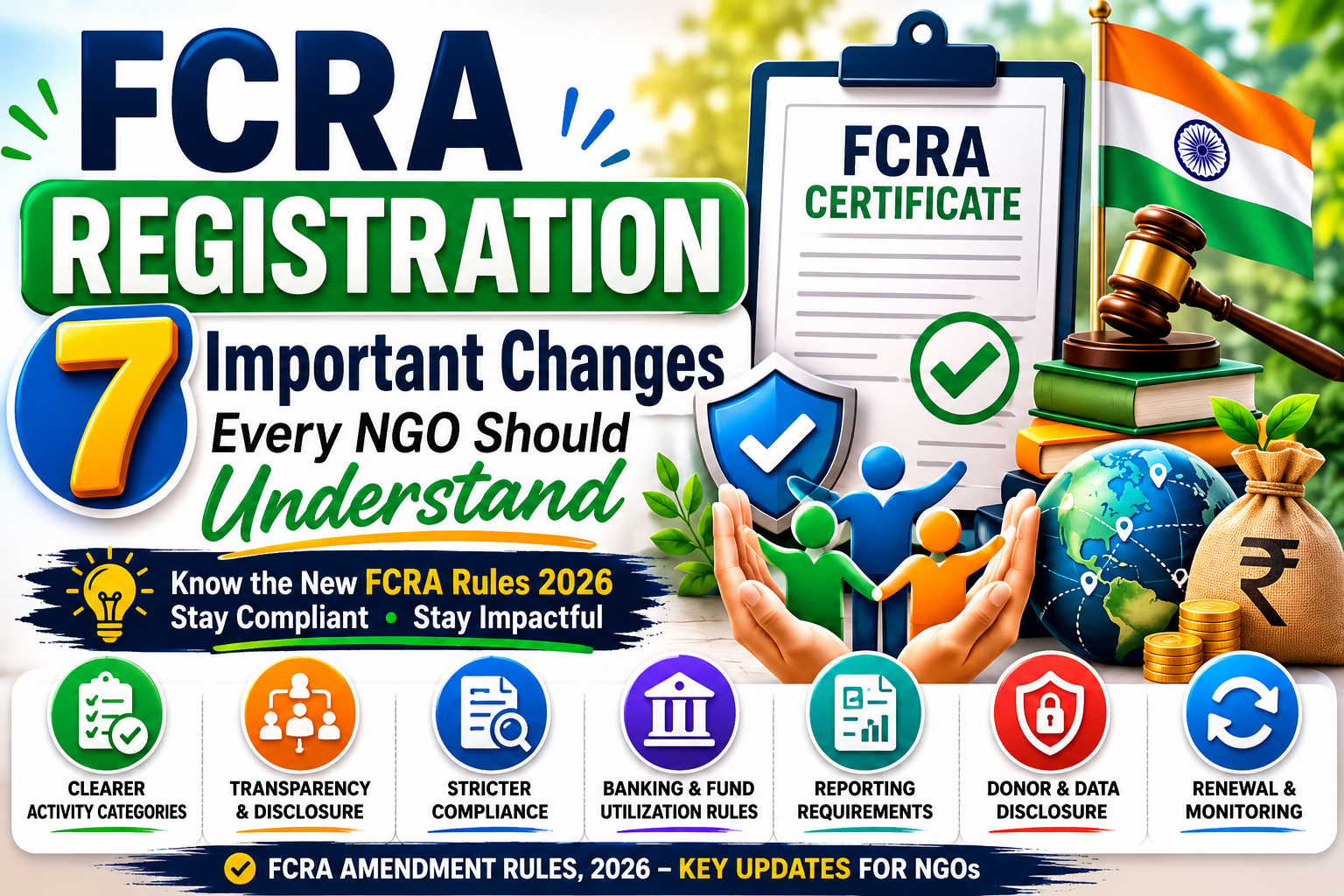
FCRA Registration: 7 Important Changes Every NGO Should Understand
Foreign funding plays a vital role in supporting thousands of non-governmental organizations (NGOs) across India. From education and healthcare to disaster relief and environmental conservation, many social impact initiatives rely on international donations to expand their reach. However, before an NGO can legally receive foreign contributions, it must complete the FCRA registration process. Governed by the Foreign Contribution (Regulation) Act, 2010, FCRA registration ensures that foreign funds are received and utilized transparently while protecting national interests. Understanding the process is essential for NGOs planning to collaborate with international donors or global development organizations. As of 2026, NGOs must also comply with the FCRA Amendment Rules, 2026, which introduce additional reporting requirements, clearer definitions of permissible activities, and enhanced transparency obligations for organizations receiving foreign contributions. These updates make it even more important for NGOs to understand the latest FCRA registration process before applying for foreign funding. This guide explains the FCRA registration process, eligibility requirements, compliance obligations, and common mistakes
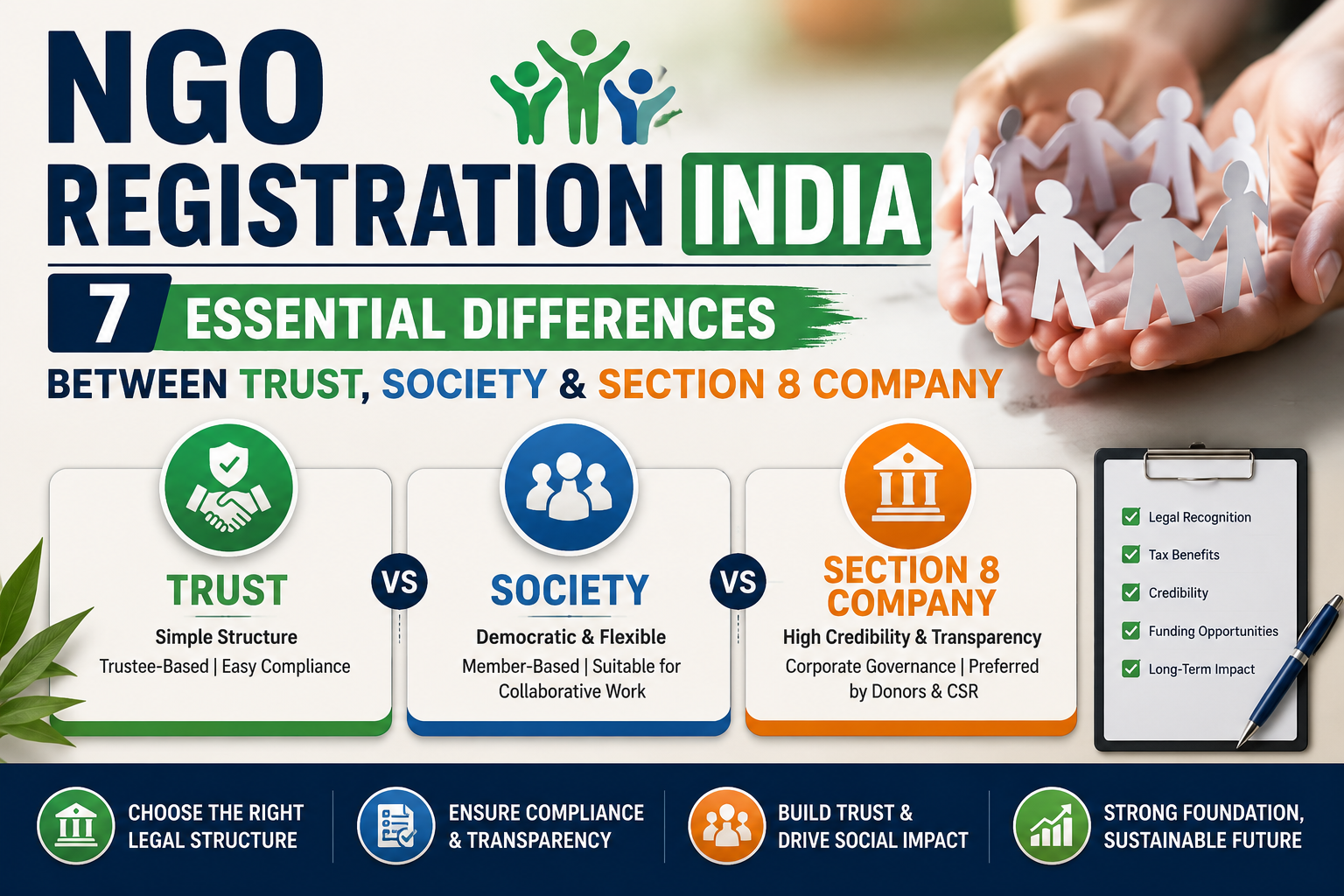
NGO Registration India: 7 Essential Differences Between Trust, Society & Section 8 Company
NGO registration India is the first and most important step in establishing a legally recognized non-profit organization. Whether you want to start a charitable trust, a society, or a Section 8 Company, choosing the right legal structure will influence your governance, funding opportunities, compliance requirements, and long-term impact. The three most common legal structures for NGO registration in India are Trusts, Societies, and Section 8 Companies. While all three can operate as non-profit organizations, they differ in terms of registration process, legal framework, management, transparency, and regulatory obligations. This guide explains the differences between each structure to help founders, social entrepreneurs, and development professionals make an informed decision. NGO Registration India: What Is It? NGO registration in India refers to the legal process of establishing a non-profit organization under the appropriate law. Registering an NGO provides legal recognition, enables organizations to open bank accounts, apply for grants, receive donations, and access tax exemptions and government schemes. The three primary legal

3-Year vs 4-Year Bachelor’s Degree: The Ultimate Guide to Better Higher Education Choices
The implementation of the National Education Policy (NEP) 2020 has introduced one of the most significant structural changes in Indian higher education in recent decades. Among its many reforms, the emergence of the four-year undergraduate degree and the possibility of a one-year master’s programme for eligible students have Confused between a 3-year vs 4-year bachelor’s degree and also sparked an important debate. Traditionally, Indian students followed a three-year bachelor’s degree followed by a two-year master’s degree. Under the new framework, many students may complete a four-year undergraduate program and subsequently pursue a one-year master’s degree, resulting in the same total duration of five years. At first glance, both pathways appear equivalent. Yet beneath this apparent similarity lies a more complex question: Do these pathways produce the same kind of graduate? The answer is not necessarily. When comparing a 3-Year vs 4-Year Bachelor’s Degree, the real distinction lies not in the number of years spent studying, but in the educational philosophy
10 Powerful Ways AI in Development Sector Is Transforming NGOs and CSR
AI in Development Sector is rapidly transforming how NGOs, nonprofits, social enterprises, and CSR programs operate. From data-driven decision-making to automated reporting and community engagement, artificial intelligence is helping organisations create greater social impact with fewer resources. As technology becomes more accessible, AI in Development Sector is emerging as a game-changing force for sustainable development and innovation. As organizations face increasing pressure to maximize outcomes with limited resources, AI in the development sector is helping professionals work smarter, reach more beneficiaries, and create sustainable solutions to complex social challenges. In this article, we’ll explore how AI is changing the development sector, the opportunities it creates, and how NGOs and social impact organizations can use AI responsibly. What Is AI in the Development Sector? AI in the development sector refers to the use of artificial intelligence technologies to improve social programs, development projects, humanitarian initiatives, and nonprofit operations. These technologies include: Organizations are increasingly using these tools to improve efficiency, reduce